
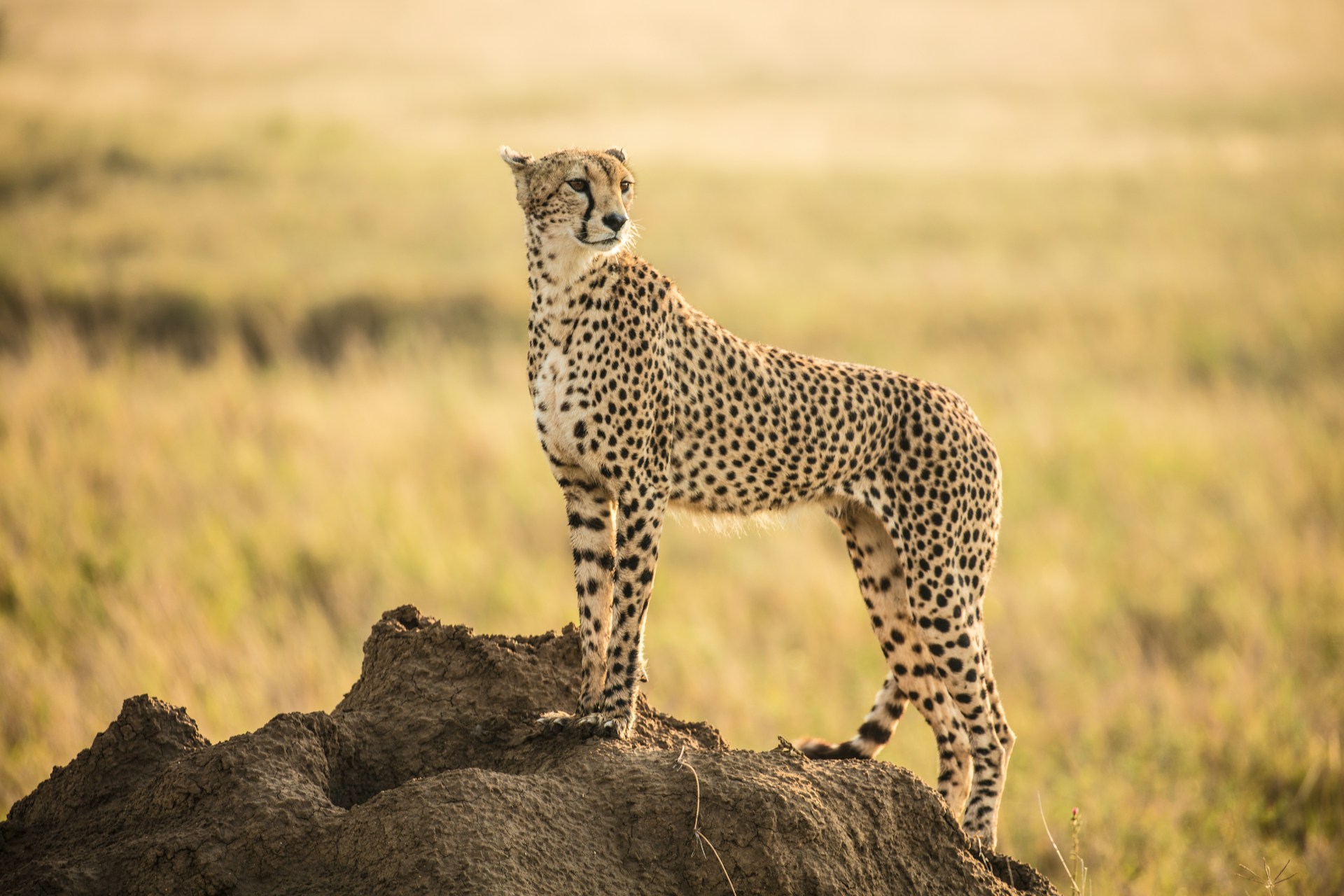
In the heart of the Masai Mara and the Serengeti, there’s an electrifying moment that seasoned guides have learned to recognise. It’s when a cheetah suddenly halts its vigilant gaze, entering a state of focused stillness. You can see the ears flatten, the tail drop, and the body subtly shift forward, as if the very air around it is charged with anticipation. What happens next is a breathtaking blur, so swift that guests who blink at just the wrong moment might miss the thrill entirely. One second, all seems calm; the next, a whirlwind of action erupts: a cloud of dust explodes, grass is sent flying, and in an instant, a Thomson’s gazelle finds itself pinned to the ground, mere meters from where the chase ignited. It’s a spectacle of nature, raw and untamed, that leaves you gasping in awe.
The whole sequence, from standing start to kill, takes less than thirty seconds.
Then the cheetah collapses.
Not from injury. Not from failure. It collapses because its body temperature has spiked to a level that, if sustained for another thirty seconds, would cause permanent brain damage. It will lie there, flanks heaving, for up to half an hour before it can eat the animal it just caught. And while it rests, every lion, hyena, and opportunistic jackal within sight distance is already moving toward the kill.
This is the cheetah’s life. The fastest land animal on earth, running a biological knife-edge every single day. Understanding that tension, between extraordinary capability and extreme fragility, is what separates a cheetah sighting from a cheetah encounter. This is the guide.
Built Differently: The Biology Behind the Speed
The cheetah’s body is an engineering solution to a single problem: how to catch prey that is nearly as fast and far more agile. Every anatomical feature points toward that one objective.
At between 40 and 65 kilograms, the cheetah is the lightest of Africa’s large cats by a considerable margin. Its frame is deep-chested for lung capacity, narrow-waisted for aerodynamics, and built on legs that are proportionally longer than a lion’s despite the cheetah being a fraction of the size. The spine functions less like a structural column and more like a coiled spring — flexing and extending with each stride to add reach that the legs alone cannot provide. At full speed, a cheetah covers eight to nine metres per stride.
The claws are semi-retractable, which is unique among the big cats. Where lions and leopards retract their claws fully to keep them sharp, the cheetah’s claws remain partially extended like a sprinter’s cleats, gripping the ground through direction changes that would send any other predator skidding. The tail, long, muscular, and used actively during the chase, functions as a biological rudder, allowing the cheetah to make sharp ninety-degree turns at sixty kilometres per hour in pursuit of prey that specialises in exactly those turns.
Top speed reaches between 110 and 120 kilometres per hour. Zero to 100 in roughly three seconds, faster than most production sports cars.
But the sprint can only be sustained for 200 to 300 metres. After that, the body’s cooling system, which is less efficient than the speed at which it enables, forces a stop. The cheetah’s success rate in hunts is around 58% — higher than lions’, which succeed in roughly 25% of attempts — but at a physiological cost that lions never pay. Every failed sprint is an energy expenditure that the cheetah cannot easily recover from. Every successful one requires that dangerous rest period before the meal can begin.
How a Cheetah Actually Hunts
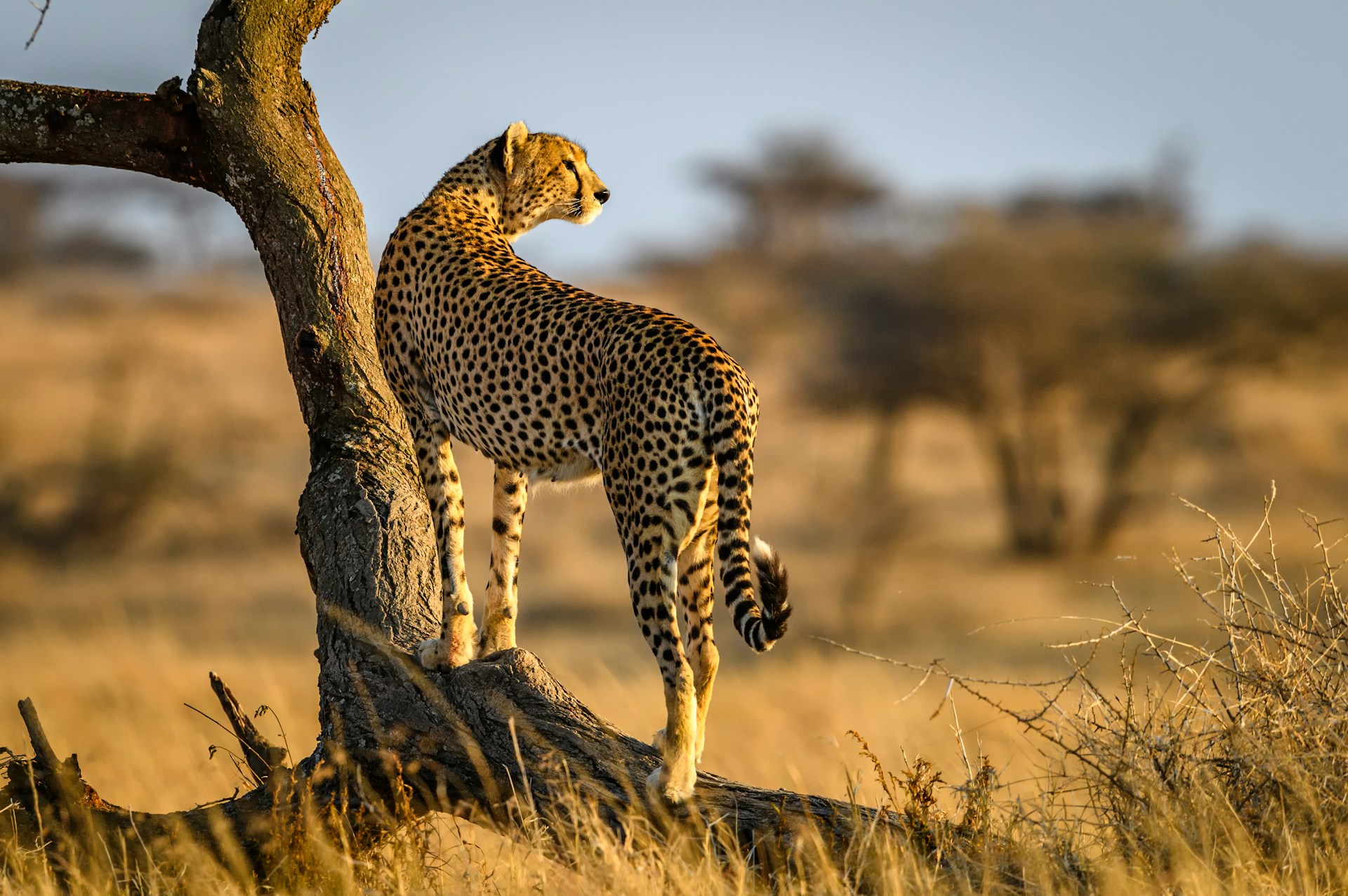
Speed is the final act. The setup is patience, positioning, and a level of observational intelligence that surprises first-time safari guests who expect big cats to simply charge.
A cheetah begins a hunt from an elevated vantage point, a termite mound, a fallen tree, or occasionally the bonnet of a safari vehicle. From there, it reads the herd, sometimes for thirty minutes or more, selecting not the closest animal but the most vulnerable: a gazelle that is grazing slightly apart from the group, one that has a slight limp, a younger animal that has drifted to the edge. George Nchau has watched cheetahs abort hunts mid-stalk because a gazelle turned to face them or a different animal moved into the path. The decision-making is deliberate, not impulsive.
The stalk follows: a slow, crouched approach using whatever cover the open plains provide, a low ridge, a termite mound, or the long grass at a drainage line. The cheetah closes to within 50 to 100 metres before the sprint begins. At that distance, the gazelle’s reaction time and the cheetah’s acceleration are almost perfectly matched. The outcome is not guaranteed.
When contact is made, the cheetah does not bite immediately. It uses a hooked dewclaw on the foreleg to trip the prey, knocking it off balance mid-stride, then clamps the throat to cut off airflow. The kill is clean by design; the cheetah cannot afford a prolonged struggle. Any injury sustained during the hunt is potentially fatal for an animal with no pride to protect it and no ability to scavenge when it cannot run.
The Social Lives Most Guides Never Explain
The popular image of a cheetah is solitary and female. That image is incomplete.
Female cheetahs are indeed largely solitary outside of raising cubs. Their home ranges are enormous, up to 1,000 square kilometres in the Serengeti, and they move through them continuously, following prey. They interact with males only to mate and spend no time building a territory to defend. The cubs stay with their mother for up to eighteen months, learning to hunt through a process that is as deliberate as any formal instruction: the mother initially brings live prey to the cubs so they can practice chasing before they need to succeed on their own.
Male cheetahs operate differently. Brothers from the same litter frequently remain together for life, forming coalitions of two to five individuals. These coalitions are among the most stable social bonds in the cat world. They hunt cooperatively, take down prey larger than any individual could manage alone (wildebeest, topi, young zebra) and defend territory from rival males with a collective effectiveness that solitary males cannot match.
The Tano Bora coalition in the Masai Mara became one of the most documented wildlife stories in East Africa before the group began breaking apart through natural attrition. Five adult male cheetahs hunting together on the open plains, coordinating pursuits with a sophistication that researchers are still working to fully understand. It is the kind of sighting that happens perhaps once in a career.
In the Serengeti, Laban Swai has tracked coalitions of three brothers across the central plains for years. The same individuals, the same routes, the same coordinated dynamic. The Serengeti’s scale — nearly 15,000 square kilometres of continuous ecosystem — allows these coalitions to operate across ranges that Masai Mara cheetahs, hemmed in by agriculture on three sides, cannot access.
Where the Cheetah Stands: A Species Under Real Pressure
Fewer than 7,100 cheetahs remain in the wild globally. They now occupy approximately nine percent of their historic range — an area that once stretched from the Indian subcontinent across the Middle East and through the length of Africa. That range has contracted within a single human lifetime into isolated pockets of southern and eastern Africa, with Kenya and Tanzania together holding one of the last genuinely viable East African populations.
Kenya’s cheetah population is estimated at between 800 and 1,500 individuals, depending on the survey and methodology. The Mara-Meru Cheetah Project, which has tracked individuals in the Masai Mara ecosystem since 2011, maintains one of the most detailed population records in Africa. The Masai Mara ecosystem, the national reserve plus the surrounding conservancies, holds approximately 80 identified individuals as tracked by the project. Tanzania’s Serengeti ecosystem supports a larger population, benefiting from the sheer scale of protected habitat.
The threats are not mysterious. They are documented, ongoing, and interconnected.
Habitat loss is the primary driver. As agriculture expands across Kenya and Tanzania’s unprotected lands, cheetah habitat fragments into isolated pockets between which individuals cannot safely move. More than 70% of Kenya’s cheetahs live outside protected areas, on farmland and community land where their prey competes directly with livestock.
Human-wildlife conflict follows directly from that overlap. A cheetah that kills a goat on community land is a cheetah at risk of retribution. Unlike lions, which have a long history of cultural management and uneasy coexistence with Maasai pastoralists, cheetahs occupy an ambiguous space — feared enough to be killed but not culturally significant enough to be protected. The Mara Cheetah Project works specifically on community engagement alongside its research programme, helping pastoralists understand cheetah behaviour and reducing the retribution killings that have historically gone undocumented.
Cub mortality is devastating. Lions kill cheetah cubs opportunistically, not from predatory intent but from competitive exclusion of a rival species. Survival rates for cheetah cubs in the Masai Mara are among the lowest recorded for any large cat population. Studies have documented that in some years, more than 90% of male cheetahs in the Mara disappear without their fate being confirmed, and breeding female populations have declined by 75% within short survey windows.
Illegal trafficking adds a further dimension. Cheetah cubs are trafficked from East Africa to the Arabian Peninsula as exotic pets, driven by demand in Gulf states where owning a cheetah carries status value. Cubs taken from the wild die at an estimated 80% rate during trafficking before they reach a buyer. Every cub removed from a wild population removes a future breeding female or coalition male from a gene pool that can ill afford the loss.
The cheetah is classified as Vulnerable on the IUCN Red List globally, and as Endangered under Kenya’s Wildlife and Conservation Management Act. Both classifications are accurate. Neither is sufficient.
Where to See Cheetahs in Kenya and Tanzania
Understanding the biology makes the difference between a sighting and an experience. Knowing where and when to go is what makes the sighting possible in the first place.
Spot Cheetahs in the Masai Mara, Kenya
The Masai Mara and its surrounding conservancies hold the highest cheetah density in Kenya and one of the highest in East Africa. The private conservancies (Naboisho, Olare Motorogi, and Mara North in particular) are where the most meaningful encounters happen. Vehicle numbers are capped, off-road tracking is permitted, and guides can follow a cheetah through long grass in a way that is simply not possible on the main reserve road network.
The dry season, from June through October, gives the best odds. Short grass means longer sightlines. Cheetahs use termite mounds as vantage points throughout the day, and an experienced guide who knows individual animals by their spot patterns, every cheetah’s markings are unique, like a human fingerprint, can locate specific individuals reliably rather than searching blindly.
Spotting them in Amboseli, Kenya
Amboseli holds a smaller resident cheetah population but offers something the Mara cannot: open plains backed by the silhouette of Kilimanjaro. A cheetah hunt on the Amboseli flats against that backdrop is one of the most visually dramatic wildlife encounters in Africa. January and February are the strongest months — dry, clear, and with elephant herds concentrated around the swamps that draw prey species and the predators that follow them.
Cheetahs in Serengeti, Tanzania
Tanzania’s Serengeti is the largest continuous cheetah habitat remaining in East Africa. The central plains — Seronera and the area around Ndutu in the southern Serengeti — hold resident populations that Laban Swai has tracked across multiple visits. The scale of the Serengeti means fewer vehicles per square kilometre than the Mara, and cheetah sightings away from the main tourist circuits can feel genuinely remote.
The calving season from January to March, when Thomson’s gazelle give birth on the short-grass plains of the southern Serengeti, concentrates cheetah activity into a relatively small area with extraordinary intensity. Prey is abundant, young and inexperienced, and cheetah hunting success rates during this window are the highest of the year. This is the Serengeti experience that goes entirely undiscussed in most safari planning conversations.
Ngorongoro Crater, Tanzania
The Crater floor holds a small and closely monitored cheetah population. Sightings are less frequent than in the Serengeti or Mara due to the density of competing predators — lions and hyenas in the Crater are present in numbers that keep cheetah density suppressed. But when a sighting does happen in the Crater’s contained volcanic bowl, with the rim walls rising on all sides, there is no comparable landscape context anywhere in East Africa.
What Makes a Cheetah Sighting Different From Any Other
Most safari guests list lions as their priority animal. A significant number leave East Africa, saying the cheetah encounter was the one that stayed with them.
Part of it is timing; cheetahs hunt by day, in full light, at close range. You see everything. Part of it is the intimacy of the animal itself: where lions are indifferent to vehicles and leopards are elusive, cheetahs are simply absorbed. They ignore the Land Cruiser almost entirely, going about their day with a focused intensity that makes the experience feel less like observation and more like proximity to something genuinely wild.
And part of it is knowing, now, what the animal is actually doing. The long scan from the termite mound is not waiting; it is selection. The slow crouch through the grass is not laziness; it is calculation. The collapse after the kill is not weakness — it is the cost of being the fastest thing alive.
When you understand the biology, you stop watching and start reading. That is when a good guide becomes essential and when a cheetah sighting becomes something you carry home.
See Cheetah in the Wild With Kwezi Safaris
Kwezi Safaris builds private itineraries across Kenya and Tanzania, specifically around the wildlife experiences that matter most to you. If a cheetah encounter is a priority, George Nchau and Laban Swai know where individual animals are, which conservancies offer the best off-road access, and how to time a visit to the Serengeti’s calving season to maximise hunting activity.
No shared vehicles. No fixed itineraries. Just the right place, at the right time, with guides who have spent decades reading this landscape.
Contact Diana Muimi at sales@kwezisafaris.com or call +254 745 522 208 to start planning.