
The question arrives in Diana Muimi’s inbox almost every week, worded in half a dozen different ways but always asking the same thing: Kenya or Tanzania?
It is a reasonable question. Both countries share the Serengeti-Mara ecosystem, the same continuous stretch of savannah grassland that hosts the Great Migration, the same Big Five, the same predator-prey dynamics that have made East Africa the benchmark for wildlife travel everywhere else on the planet. On a map, they look like adjacent pieces of the same puzzle.
But they do not feel the same. They do not operate the same. And the mistake most travellers make is not choosing the wrong country; it is choosing based on the wrong criteria entirely.
George Nchau has led private safaris across Kenya for over twenty years. Laban Swai has guided the Serengeti and Ngorongoro for longer than most of their guests have been planning safaris. Between them, they cover both sides of the border for every Kwezi itinerary that crosses it. What follows is their honest assessment — not a brochure comparison, not a verdict with a sponsor behind it, but the actual framework two experienced guides use when a guest asks them which country to choose.
They Share an Ecosystem. They Do Not Share an Experience.
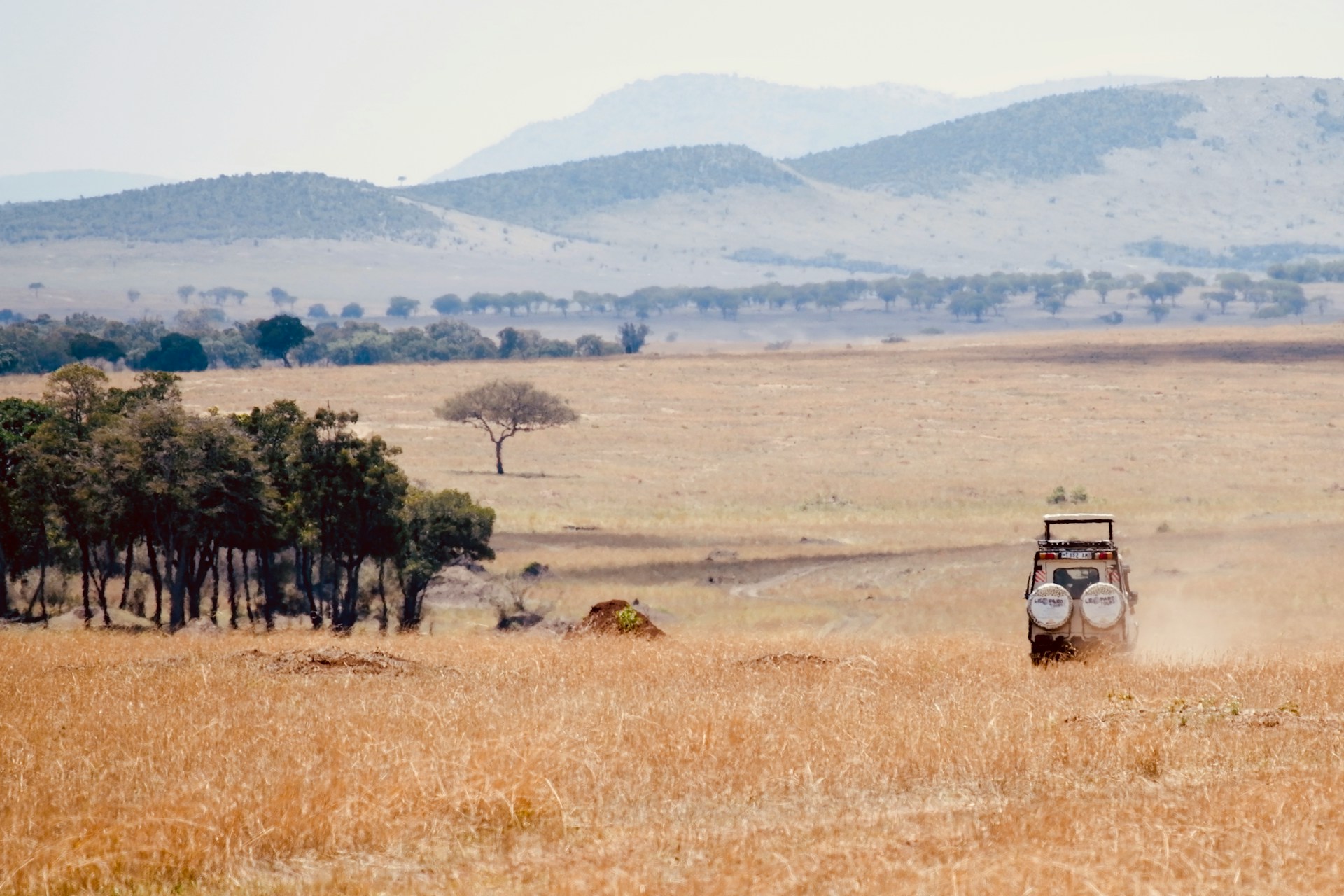
Start here, because most comparisons skip it: the Masai Mara and the Serengeti are not two separate wildlife destinations that happen to be near each other. They are one continuous ecosystem divided by a political border drawn in the colonial era. The wildebeest do not know which country they are in. The lions do not check their passports at the Mara River.
What the border does create is two genuinely different safari products built on the same biological foundation. Kenya’s side of that ecosystem (the Masai Mara and its surrounding conservancies) is smaller, more concentrated, and more developed for tourism. Tanzania’s side (the Serengeti, Ngorongoro, Tarangire, and the broader northern circuit) is larger, more varied, and by most measures more immersive.
The wildlife is largely the same. The experience of encountering it is not.
What Kenya Does Better
Accessibility and logistics
Kenya is easier. That is not a slight — it is a practical advantage that shapes everything from the cost of a domestic flight to the number of parks you can realistically cover in five days.
Nairobi is one of the best-connected airports in Africa, with direct flights from London, Amsterdam, New York, and a dozen other long-haul hubs. Wilson Airport, Nairobi’s domestic terminal, sits twenty minutes from the city centre and runs scheduled flights to the Masai Mara, Amboseli, Samburu, and Laikipia throughout the day. A guest landing at JKIA in the morning can be on a game drive in the Mara by early afternoon.
Tanzania’s logistics are workable but add complexity. Nairobi remains the most common entry point for northern Tanzania safaris, with guests flying to Kilimanjaro International Airport or taking a charter flight directly into the Serengeti. The distances between Tanzania’s major parks are significant. A classic northern circuit — Tarangire, Serengeti, Ngorongoro — requires either multiple domestic flights or long overland transfers between camps.
For a five to seven-day safari, Kenya’s compactness is a genuine advantage. More time in the bush, less time in transit.
Predator density in the Masai Mara conservancies
The private conservancies bordering the Masai Mara National Reserve — Naboisho, Olare Motorogi, Mara North — hold some of the highest predator concentrations on the continent. George has counted cheetah coalitions, lion prides, and leopard sightings within two hours on a single game drive in Olare Motorogi. The combination of strict vehicle limits, off-road tracking permission, and night drive access creates an encounter quality in the conservancies that is difficult to match anywhere in Tanzania outside of a few premium private concessions.
For guests whose primary priority is big cat sightings — and specifically for photographers who want time with animals without competing vehicles — the Mara conservancies represent the strongest single argument for Kenya.
Rhino access
Kenya’s Ol Pejeta Conservancy in Laikipia holds the largest black rhino population in East Africa and is one of the most reliable places on the continent for close rhino encounters. Lake Nakuru, while smaller in scale, offers consistent rhino sightings in a scenic Rift Valley setting. Tanzania’s rhino population is concentrated in Ngorongoro Crater, where sightings are possible but less predictable.
If completing the Big Five with a quality rhino encounter is a priority, Kenya has the stronger offering.
What Tanzania Does Better
Scale and wilderness immersion
The Serengeti is nearly 15,000 square kilometres. The Masai Mara is approximately 1,500. That tenfold size difference is not just a statistic — it changes what a safari feels like from the inside.
In the Serengeti’s central and western zones, it is possible to drive for an hour without seeing another vehicle. The horizon is unbroken in every direction. The sense of being genuinely inside a wilderness, rather than a managed wildlife experience, is more consistently available in Tanzania than in Kenya’s busier parks, particularly during peak Migration season.
Laban Swai describes the Serengeti as a safari you feel as much as see. The scale produces a different relationship with the landscape. Sightings feel less like events and more like encounters — wildlife going about its life in a space large enough that your vehicle is genuinely incidental to it.
The Migration for most of the year
This is the fact most travellers get wrong in the Kenya-versus-Tanzania debate. The Great Migration is not a Kenyan event. It is a year-round circular movement of over 1.5 million wildebeest between the two countries, and Tanzania holds the herds for nine to ten months of the year.
The calving season — January through March in the southern Serengeti’s short-grass plains — is one of the most extraordinary wildlife events on the continent and is almost entirely unknown to travellers who plan their East Africa safari around the Mara River crossings. Half a million wildebeest calves are born within a few weeks. The concentration of predators that follows is unlike anything Kenya offers at the same time of year. Lions, cheetahs, and wild dogs converge on the calving grounds with a frequency and intensity that has to be seen to be understood.
The Mara River crossings (Kenya’s headline Migration event) happen between late July and October. They are spectacular. They are also a four-month window in a twelve-month cycle. Travellers who cannot travel in those months default to Kenya for the Migration and miss nine months of the story that is happening in Tanzania.
Ngorongoro Crater
There is nothing in Kenya that is equivalent to Ngorongoro. The crater is a 260-square-kilometre volcanic caldera containing approximately 25,000 large animals in a self-contained ecosystem. The walls of the crater rise 600 metres from the floor, creating a visual context for every game drive that is unlike any open savannah in either country.
The crater holds all of the Big Five, including one of Africa’s most accessible black rhino populations. It is also one of the strongest lion-viewing destinations on the continent — the crater’s closed ecosystem concentrates prey in a space small enough that predator-prey interactions happen with a frequency that open plains simply cannot replicate.
Laban builds a Ngorongoro floor day into virtually every Tanzania itinerary he plans. It is not an optional add-on. It is a fundamentally different type of safari experience that has no Kenyan equivalent.
Zanzibar as a natural extension
A Tanzania safari connects to Zanzibar with a direct forty-five-minute flight from Arusha or a charter from the Serengeti airstrips. The combination — northern circuit safari followed by four or five days on the Zanzibar coast — is one of the most satisfying travel structures in East Africa. The transition from bush to beach requires no retracing of steps, no secondary hub, no logistical complexity.
Kenya’s coast is excellent — Diani Beach and the Lamu Archipelago are both genuinely worth the trip — but the connection requires returning through Nairobi, which adds travel time and a routing that feels less seamless than the Tanzania-Zanzibar pairing.
The Comparison Most Articles Get Wrong: Cost
The prevailing narrative is that Kenya is cheaper than Tanzania. In 2026, that comparison requires more nuance than it used to.
Kenya’s national park fees increased substantially in recent years. The Masai Mara now charges $200 per adult per day during peak season — among the highest park fees on the continent. Private conservancy fees add $80 to $150 per person per night on top of accommodation. Tanzania’s fees are structured differently, with a mix of national park fees and vehicle charges, but comparable private luxury experiences in the Serengeti run at broadly similar price points to the Mara conservancies.
The honest position: a well-planned private safari in Kenya and a well-planned private safari in Tanzania at comparable quality levels cost broadly comparable amounts. Tanzania’s northern circuit covers more ground, which means more nights and more total spend. Kenya’s compactness allows a strong safari at similar quality in fewer nights. The cost difference is largely a function of trip length rather than a structural price gap between the two countries.
What both countries share is the principle that the accommodation and guide quality determine the value of the spend far more than the country itself.
The Decision Framework George and Laban Actually Use
When a Kwezi guest asks which country to choose, the answer starts with four questions.
How many days do you have? Five to seven days — Kenya is the stronger choice. The logistics work in your favour, and the Mara conservancies deliver an exceptional experience in a compact timeframe. Eight days or more — Tanzania’s northern circuit becomes viable, and the scale of the Serengeti rewards the additional time.
What is your Migration priority? River crossings specifically — Kenya, late July to October. The full Migration story, including calving — Tanzania, January to March for the most extraordinary predator concentration, or a combined itinerary that catches different chapters in different countries.
Is Ngorongoro on your list? If yes, Tanzania is non-negotiable. There is no equivalent experience in Kenya and the crater deserves at least a full day on any itinerary that includes it.
Is a beach extension part of the plan? Tanzania connects to Zanzibar with unmatched simplicity. If a safari-beach combination is the goal, Tanzania is the more elegant routing.
Why Most Travellers End Up Doing Both — And Why That Is the Right Answer
The most common outcome of the Kenya-versus-Tanzania conversation at Kwezi is not a choice. It is a combined itinerary.
Five days in the Masai Mara conservancies followed by five days on the northern Tanzania circuit is one of the most complete safari experiences available anywhere in the world. Kenya gives you the conservancy intimacy, the predator density, the accessible logistics. Tanzania gives you the Serengeti’s scale, the Ngorongoro Crater, and if the timing is right, the calving season or the southern Migration.
The two countries are not competing products. They are consecutive chapters in the same story. The border between them is a line on a map that the wildlife crossed this morning without noticing.
George handles Kenya. Laban handles Tanzania. Between them, there are no handoffs, no gaps in knowledge, and no moment where you are passed between operators who do not know each other’s work. One team, both sides of the border, one itinerary built around what you actually came to see.
Plan Your Kenya and Tanzania Safari With Kwezi
Kwezi Safaris has operated private safaris across Kenya and Tanzania since 2013. Every itinerary is built around your specific dates, priorities, and the version of East Africa you have come to experience.
Contact Diana Muimi at sales@kwezisafaris.com or call +254 745 522 208 to start the conversation. We will tell you honestly which country fits your trip — and whether the right answer is both.