
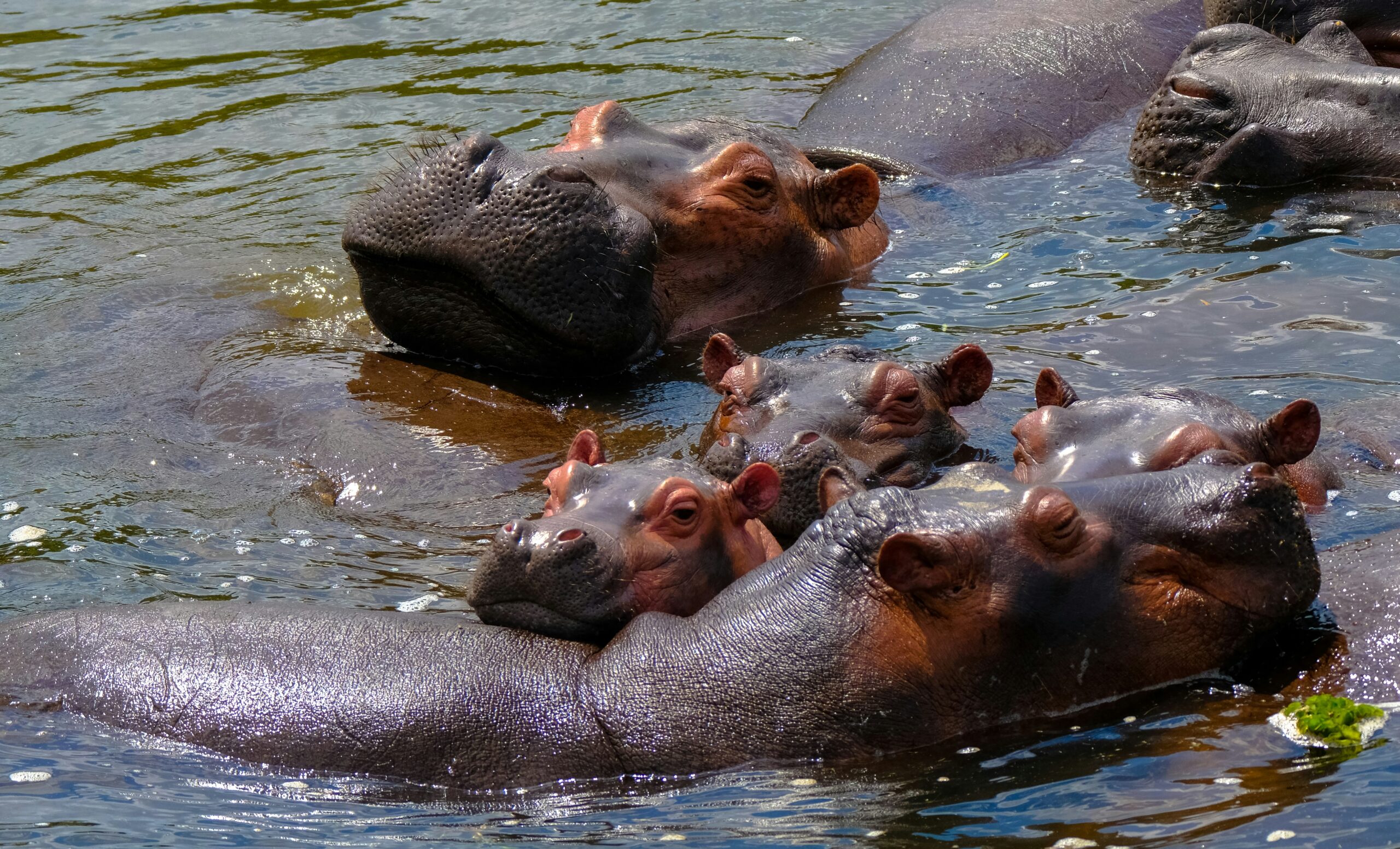
Most first-time safari guests spot a hippo in the Mara River and immediately reach for their camera. The ears are absurd. The movements are slow and deliberate. The expression, somewhere between bored and indignant, tends to invite photographs.
George Nchau has watched this happen hundreds of times over 20 years of guiding in Kenya and Tanzania. He lets guests take the photograph. Then, quietly, he explains why the animal they just photographed is statistically more likely to kill a person in Africa than a lion, leopard, buffalo, or crocodile.
The number is approximately 500 deaths per year. It tends to change the mood in the vehicle.
Hippos are one of the most comprehensively misread animals on the continent — too familiar-looking to trigger proper caution, too large to be safely ignored. This guide covers what our guides know from years in the field: hippo biology, behaviour, danger signs, where to see them safely, and why their presence in Africa’s rivers matters far beyond what most visitors understand.
Quick Hippo Facts: The Need-to-Know Basics
Before we go deeper, here is your reference overview:
Scientific Name: Hippopotamus amphibius (which literally means “river horse” in Greek)
Size: Up to 16.5 feet long, 5.2 feet tall at shoulder
Weight: Males can hit 9,920 lbs (that’s nearly 5 tons!); Females around 3,000 lbs
Lifespan: 40-50 years in the wild
Speed: Up to 30 mph on land over short distances—yes, really
Bite Force: 1,827 PSI (almost 3x stronger than a lion’s bite)
Population: Approximately 115,000-130,000 left in the wild
Conservation Status: Vulnerable (and declining)
Now that we’ve got the basics covered, let’s get into the good stuff.
Why the Hippopotamus Is Africa’s Most Dangerous Large Animal
Teeth Designed as Weapons, Not Tools
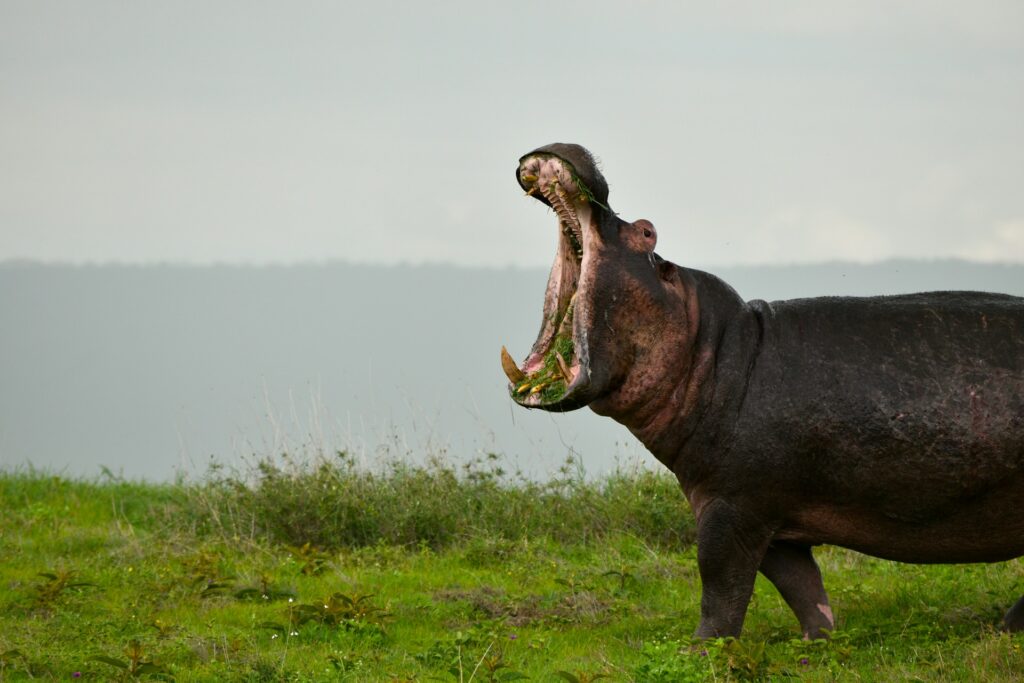
A hippo’s canine teeth can reach 20 inches in length — longer than a standard ruler, and maintained at a sharp edge through constant use. When a hippo opens its jaw, the gape extends 150 to 180 degrees, producing a four-foot opening that serves one purpose in conflict situations: intimidation and attack.
The bite force behind that jaw is 1,827 PSI. That is powerful enough to bisect a small boat. It is also significantly more force than any predator on the continent applies with a single strike. Guides who have worked the rivers of the Mara and Serengeti for years will tell you that a hippo bite is not a warning — it is a conclusion.
What matters practically is that those teeth are not used for eating. The big canines and incisors are purely weapons. Hippos graze with thick, muscular lips and rear molars. The front teeth exist entirely for territorial display and combat.
Fast? Hippos? You’re Kidding, Right? The Speed Problem
Look at a hippo, and the instinct is to assume it moves slowly. The barrel body, the short legs, the general architecture of an animal that spends 16 hours a day stationary in water, nothing about the appearance suggests urgency.
Hippos charge at up to 30 mph on land. For context, Usain Bolt’s peak recorded speed was 27.33 mph. On open ground, there is no scenario in which a person on foot outpaces an animal that has decided to charge. The distance closes faster than most people can register it has started.
There is a secondary movement fact that surprises almost every guest: hippos cannot swim. They are too dense to float. Instead, they walk, run, or gallop along the riverbed in a slow-motion push-off sequence that reads as graceful until you understand what is happening. They can hold their breath for up to five minutes and cross significant distances underwater entirely on foot.
Why Hippos Kill More People Than Predators Do
Hippos are responsible for an estimated 500 human deaths per year in Africa — more than lions, leopards, buffalo, and crocodiles combined. This is not because they are predatory. It is because they are territorial and because they give very little warning before acting on that territorial instinct.
The circumstances that most commonly produce attacks:
Getting between a hippo and its water source — this is the single most common trigger. The water is the hippo’s safety. It will move through whatever is between itself and that safety.
Surprising a grazing hippo on land at night — hippos feed nocturnally, often kilometres from their daytime river. An unexpected encounter in darkness gives neither party time to assess the situation.
Coming near a mother with a calf — maternal defence in hippos is absolute.
Approaching from a blind angle when an animal is already alert — an agitated hippo that cannot identify the source of the disturbance will often default to charge.
The reason experienced safari guides give hippos more physical respect than they give lions is not drama — it is that the warning behaviour before a lion charges is much more readable. Hippos escalate quickly and with less observable preparation
Built Different: The Hippopotamus Body Explained
Hippos are semi-aquatic mammals whose entire physiology is structured around the transition between deep water and open grassland. They have solved problems that would be impossible for most large mammals.
Their head geometry is designed for submersion. Eyes, ears, and nostrils sit on the highest points of the skull, which means a hippo can maintain vision, hearing, and breathing while keeping the vast majority of its body below the waterline. When they submerge completely, ears and nostrils seal automatically. Protective membranes cover the eyes. An adult can remain underwater for five minutes while walking the riverbed normally.
The body itself is predominantly muscle and dense bone, with very little fat. This density is what allows them to sink and move on the riverbed rather than floating at the surface. A hippo that wanted to swim in the conventional sense would be unable to — the buoyancy simply is not there.
The Secretion That Is Not Blood and Not Sweat
Hippos have no sweat glands. The reddish-orange liquid that appears to seep from their skin in heat, and that gave rise to the ancient observation that they sweat blood, is a bio-secretion that functions as three things simultaneously: sunscreen, moisturiser, and antibiotic.
The secretion blocks UV radiation, preventing the skin from cracking that would occur during the hours spent above water in the African sun. It maintains skin hydration. And research has confirmed it carries antimicrobial properties that help wounds heal cleanly despite the regularity with which territorial males injure each other.
Without it, hippos would be in serious physiological difficulty. Their skin is considerably more sensitive than its appearance suggests, and the secretion is a continuous, non-behavioural adaptation that runs beneath any other activity.
Size in Context
The hippopotamus is the third-largest land mammal, after the elephant and white rhinoceros. A full-grown male reaches 11.5 feet in length and stands approximately five feet at the shoulder. Weight ranges up to four tons for large bulls. Females are roughly 30% smaller.
A Day (and Night) in the Life
Daytime: The River as Refuge
As daylight increases, hippos enter the water and remain there for up to 16 hours. This is not principally a social behaviour — it is thermoregulation. The African sun, combined with skin that lacks a functional sweat response, makes the water a physiological necessity rather than a preference.
A typical hippo pool holds 10 to 200 individuals, with 20 to 30 being most common. The social dynamics within that pool are not passive. Dominant males maintain territories — specific sections of river — and younger males are constantly negotiating their peripheral position within the group. What looks like a static collection of animals is a continuous, low-level political exercise.
Nighttime: The Grazing Circuit
As light fades, hippos leave the water and move inland to graze. They follow established routes to pasture — paths worn so consistently that they become permanent features of the landscape, visible as corridors through vegetation and compressed earth along riverbanks.
A single hippo will travel up to six miles from its water source during a night’s grazing and consume 80 to 100 pounds of grass — roughly 1 to 2% of its body weight. The relative modesty of this intake reflects an efficient digestive system that ferments food over a long cycle, and the energy savings of spending the heat of the day largely still in temperature-controlled water.
One practical point for anyone camping in hippo territory: identify established hippo paths before pitching a tent. Hippos are creatures of absolute habit, and will not divert around an obstacle on a route they have used for years.
The Territorial System
Male hippos establish and defend river territories for periods of 10 to 12 years at a time. These territories are not simply preferred resting spots — they are mating positions. Females congregate in dominant bulls’ territories, particularly during the dry season when water concentrates, and mating rights flow from territorial control.
Most territorial confrontations between bulls are resolved through display rather than combat. A face-off typically involves:
Wide jaw gapes — the canine display at its most explicit
Loud bellowing and sustained vocalisation
Sustained water splash sequences
Dung-flinging: hippos mark territory by rotating their tail rapidly while defecating, distributing the material in a wide arc. It is effective.
When display fails and physical combat occurs, it can be lethal. Bulls slash at each other’s flanks with lower canines, and deep wounds in the abdominal region, even protected by skin up to two inches thick, can become fatal. But actual contact fighting is the exception; the display system resolves the majority of territorial disputes without injury.
Why Hippos Shape Entire River Ecosystems
Ecologists classify hippos as keystone species and ecosystem engineers — terms that mean their presence or absence has structural effects on the entire environment around them, far beyond what their diet or behaviour would directly suggest.
The Nutrient Transfer System
Hippos graze on land at night and defecate in water during the day. This behaviour transfers large quantities of terrestrial nutrients — primarily nitrogen and phosphorus — directly into river systems. Those nutrients feed algae, aquatic plants, invertebrate larvae, and ultimately fish populations that local communities depend on for protein.
Research suggests that healthy hippo populations transfer tons of nutrients from land to water annually per river system. The fish downstream of a healthy hippo pod are, in a real sense, supported by what those hippos ate the night before.
The system has a failure condition. When water flow is restricted by drought, damming, or diversion, hippo dung accumulates in stagnant pools rather than washing downstream. Oxygen levels collapse. Toxic algae blooms. Fish populations crash. The same process that sustains a healthy river becomes destructive when the flow that disperses it is removed. It is a direct demonstration of how interconnected these systems are.
Landscape Maintenance
The nightly grazing circuits that hippos follow maintain open grassland corridors around wetland margins that other species use as pathways to water. Their trimming prevents succession growth from closing off access points that smaller animals depend on. When hippo populations decline, these corridors close, vegetation structure changes, and the landscape becomes less navigable for a range of other species.
The Conservation Reality
Hippopotamus populations have been classified as Vulnerable on the IUCN Red List since 2006. The global population of 115,000 to 130,000 represents a significant decline from historical numbers, and the trajectory continues downward.
Habitat loss is the primary pressure. Hippos require a specific combination: permanent deep water for daytime refuge and accessible grassland within feasible grazing distance. As wetlands are drained, rivers dammed, and land converted to agriculture, this combination becomes rarer.
Poaching operates in a legal grey area that widened after the 1989 elephant ivory ban redirected commercial hunting pressure onto hippos. Their teeth are sold as ivory substitutes. Their meat is commercially valuable in several range countries. Despite protection in most nations, enforcement in remote river systems is inconsistent.
Human-wildlife conflict generates retaliatory killing when hippos raid crops — a behaviour that increases as natural grazing areas shrink. Communities that bear the cost of hippo damage without compensation or support have limited incentive to tolerate the animals.
The Virunga case is worth noting because it runs in the other direction. Virunga National Park in the Democratic Republic of Congo held approximately 29,000 hippos in the 1970s. By 2005, sustained conflict and poaching had reduced that to fewer than 900. Targeted conservation intervention — better enforcement, community engagement, sustained funding — has produced a measurable recovery. It confirms that the trend is not inevitable.
Some Good News (We Need It)
But it’s not all doom and gloom. There are success stories that prove conservation works when we commit to it.
Take Virunga National Park in the Democratic Republic of Congo. In the 1970s, this park was home to about 29,000 hippos. Then came civil conflict, poaching, and chaos. By 2005, fewer than 900 hippos remained. It was devastating.
But then something changed. Better enforcement, community engagement, and dedicated conservation efforts started turning things around. The population is recovering. It’s proof that when we protect hippos and their habitat, they can bounce back.
The Pygmy Hippo Situation
The common hippo’s smaller relative deserves separate mention. The pygmy hippopotamus, a distinct species found only in the forests of West Africa, weighs approximately 600 pounds, lives largely alone, and is classified as Endangered with fewer than 2,500 mature individuals remaining. It receives a fraction of the attention directed at its larger relative, and its forest habitat is being removed by logging and agriculture faster than conservation infrastructure is being built to respond.
Safari Safety Around Hippos: What the Guides Know
The following is not generic travel advice. It is what our guides in Kenya, Tanzania, and Uganda brief guests on before any river-adjacent game drive or boat safari.
The Non-Negotiable Rules
Do:
Maintain at least 30 metres (approximately 100 feet) between yourself and any hippo on land
Stay inside the vehicle at all times unless your guide explicitly directs otherwise
Reduce engine noise and conversation near active hippo pools — the animals are more relaxed when they cannot identify a specific threat
Give any hippo on land a clear, unobstructed path to the nearest water — do not position yourself or the vehicle in that line of movement
Apply maximum caution at dawn and dusk, when animals are transitioning between water and land and are most likely to encounter people unexpectedly
Do not:
Position yourself between a hippo and its water source under any circumstances
Approach a cow with a calf
Camp on or near worn pathways adjacent to rivers and lakes — these are established grazing routes and the animals will use them through the night
Interpret a wide-open jaw as relaxation — it is the primary threat display and means the animal has registered you as a problem
Turn your back on a hippo that has noticed you.
Reading What the Animal Is Communicating
Jaw gape directed at you: Move away immediately and give the animal a clear path to water. This is the final warning, not the first.
Sustained bellowing or deep grunting: The animal is agitated and escalating. Stop movement, reduce noise, and let your guide direct the response.
Repeated dramatic surface splashing: Another escalation signal. This is not play behaviour.
Direct sustained eye contact from a stationary animal: The hippo has identified you as a potential threat and is assessing it. Do not make sudden movements.
Tail rotation while stationary in water: Dung-marking behaviour — you are within the territorial boundary.
The most controllable situation is one where the hippo has not registered your presence at all. The second safest is one where it has registered you, assessed you as non-threatening, and returned to normal behaviour. An animal that is actively displaying is in a different category, and the appropriate response is always distance.
Where to See Hippos in Africa: A Guide to the Best Locations
Boat-based viewing at water level gives you a relationship with hippos that a vehicle on a bank cannot replicate. The surface reflection, the ambient sound, and the proximity to animals that are behaving normally rather than watching an elevated vehicle create an entirely different observational experience. Where possible, we design hippo encounters around this format.
Queen Elizabeth National Park, Uganda: The Kazinga Channel boat safari is our primary recommendation for guests who want extended, high-quality hippo viewing. The channel connects Lake Edward and Lake George and is used by some of the densest hippo concentrations in East Africa. A two-hour boat safari in calm, shallow water places guests alongside pods of 50 or more animals engaged in normal social behaviour — territorial posturing, calf interactions, dominance displays between bulls. The boat maintains movement and distance that the animals have become accustomed to, so what you observe is undisturbed behaviour rather than a threat response.
Serengeti National Park, Tanzania: The Retima Hippo Pool in the western corridor holds significant concentrations, particularly during dry season when water levels drop and animals concentrate in the remaining pools. Pod sizes at Retima can exceed 200 individuals on a single sandbank. Laban Swai, our Tanzania operations specialist, incorporates this into western Serengeti itineraries and advises on timing within the season to maximise the density of the encounter.
Lake Naivasha, Kenya: A 90-minute drive from Nairobi, Naivasha offers boat-based hippo viewing on a freshwater lake, making it accessible for guests earlier in a Kenya itinerary or as a standalone day excursion from the capital. The floating papyrus islands allow boats to approach within close range without entering direct territorial space.
Murchison Falls National Park, Uganda: The boat trip from Paraa to the base of the falls passes through hippo territory for the full journey. The combination of the falls themselves, crocodile concentrations on the banks, and dense hippo pods along the river makes this one of East Africa’s most layered single boat experiences.
Chobe National Park, Botswana: Evening river cruises on the Chobe place guests at eye level with hippos using the channel that forms the Namibia-Botswana border. Late-afternoon light on the water, combined with the density of animals along this stretch, makes Chobe one of the most photographable hippo locations on the continent.
Plan a safari that includes boat-based hippo viewing — contact the Kwezi Safaris team
Hippopotamus Facts: Frequently Asked Questions
Why are hippos considered Africa’s most dangerous animal? Hippos kill an estimated 500 people per year in Africa — more than lions, leopards, buffalo, and crocodiles combined. The reasons are primarily behavioural: they are highly territorial, move faster than most people expect (up to 30 mph on land), and give very little observable warning before charging. Most attacks occur when people accidentally position themselves between a hippo and its water source, or encounter a grazing animal in darkness. The danger is not predatory — hippos are herbivores — it is territorial.
Can hippos actually swim? No. Hippos are too dense to float and cannot swim in the conventional sense. Instead, they walk, run, or push off the riverbed in a controlled gallop that allows rapid underwater movement. Their ears and nostrils seal automatically when submerged, and they can hold their breath for up to five minutes. Despite spending most of their lives in or adjacent to water, their relationship with it is one of walking along the bottom, not swimming through the surface.
What is hippo “blood sweat”? Hippos produce a reddish-orange oily secretion from their skin that functions simultaneously as sunscreen, moisturiser, and antibiotic. It is not blood, and hippos have no sweat glands — the secretion comes from specialised skin glands unique to the species. The antimicrobial properties help heal the wounds that territorial combat between bulls regularly produces. Without this secretion, hippo skin would crack and become infected rapidly in African conditions.
What does a hippo yawn actually mean? A wide-open jaw display in a hippo is not a sign of tiredness — it is the primary threat display, used to show canine teeth that can reach 20 inches in length. When a hippo directs this display toward you, it has identified you as a threat and is communicating it. The appropriate response is to move away immediately and give the animal a clear, unobstructed path to water.
How close can you safely get to a hippo? The standard minimum safe distance on land is 30 metres (approximately 100 feet). On water, a properly guided boat safari maintains approach angles and distances that minimise perceived threat — experienced guides read the animals’ responses continuously. The most important rule in any hippo encounter on land is to never position yourself between the animal and its water source. That route is the one a hippo will always take, regardless of what is in the way.
Are hippos endangered? Common hippos are classified as Vulnerable on the IUCN Red List, with a global population of approximately 115,000 to 130,000 individuals. The population is declining due to habitat loss, illegal hunting for meat and ivory substitution, and human-wildlife conflict. The pygmy hippopotamus — a separate species found only in West African forests — is classified as Endangered, with fewer than 2,500 mature individuals remaining.
Where is the best place to see hippos in Africa? For boat-based viewing at water level, the Kazinga Channel in Uganda’s Queen Elizabeth National Park is our top recommendation — pod sizes are exceptional and the boat format allows extended, undisturbed observation. The Retima Hippo Pool in Tanzania’s Serengeti western corridor, Murchison Falls in Uganda, and the Chobe River in Botswana are also among the continent’s best locations. Lake Naivasha in Kenya is the most accessible from Nairobi for a day excursion.
Final Thoughts
A hippo is not a background detail on a Kenya or Tanzania safari. It is a foreground event — several tons of territorial muscle sharing a river with your boat, audible across the water at sunset, and present in the camps along the Mara where the sound of grazing carries on nights when the wind is right.
The facts in this guide matter because understanding what you are looking at changes the quality of the experience. A pod of 80 hippos is not a scene — it is a social structure, a nutrient cycle, an ecosystem in active operation. The deep grunt from the riverbank at dusk is not atmosphere; it is a territorial declaration that has functioned unchanged for 55 million years.
Kwezi Safaris builds hippo viewing into Kenya, Tanzania, and Uganda itineraries in ways that produce genuine encounters rather than passing sightings. The Kazinga Channel boat safari. The Retima Pool in the western Serengeti. River-adjacent camps in the Mara where the night sounds are part of the experience, not an accident of where the tent was placed.
If you are planning a safari and want to know which location and timing gives you the best hippo experience for your specific travel window, ask us directly. George and the team give specific answers, not general ones.
Contact Kwezi Safaris to start planning your safari
Kwezi Safaris is licensed by the Kenya Tourism Regulatory Authority, a Travelife Partner, and a member of Eco-Tourism Kenya.