Imagine this: you’re on an exhilarating safari, camera poised, and suddenly your eyes land on a giant, charming water potato basking in a river. You can’t help but chuckle at its cartoonish appearance, but hold on, your guide chimes in with a shocking reminder: that “adorable” hippo is actually Africa’s most dangerous large animal, taking the lives of around 500 people each year! That’s right, more than lions, crocodiles, or any of the other fearsome predators we usually worry about.
How can a creature that primarily munches on grass and spends its days lounging in water be so lethal? Buckle up, because we’re about to explore the wild and fascinating world of hippos! Whether you’re gearing up for your first African adventure or are simply a wildlife enthusiast (like me!), understanding these incredible yet hazardous giants isn’t just intriguing, it could be life-saving!
So let’s plunge headfirst into the realm of hippos and unveil what makes them not only remarkable and dangerous but also vital to the ecosystems of Africa!
Quick Hippo Facts (The Need-to-Know Basics)
Before we go deep, here’s your hippo cheat sheet:
Scientific Name: Hippopotamus amphibius (which literally means “river horse” in Greek)
Size: Up to 16.5 feet long, 5.2 feet tall at shoulder
Weight: Males can hit 9,920 lbs (that’s nearly 5 tons!); Females around 3,000 lbs
Lifespan: 40-50 years in the wild
Speed: Up to 30 mph on land over short distances—yes, really
Bite Force: 1,827 PSI (almost 3x stronger than a lion’s bite)
Population: Approximately 115,000-130,000 left in the wild
Conservation Status: Vulnerable (and declining)
Now that we’ve got the basics covered, let’s get into the good stuff.
So... Why is The Hippopotamus So Insanely Dangerous?
They're Basically Walking Armories
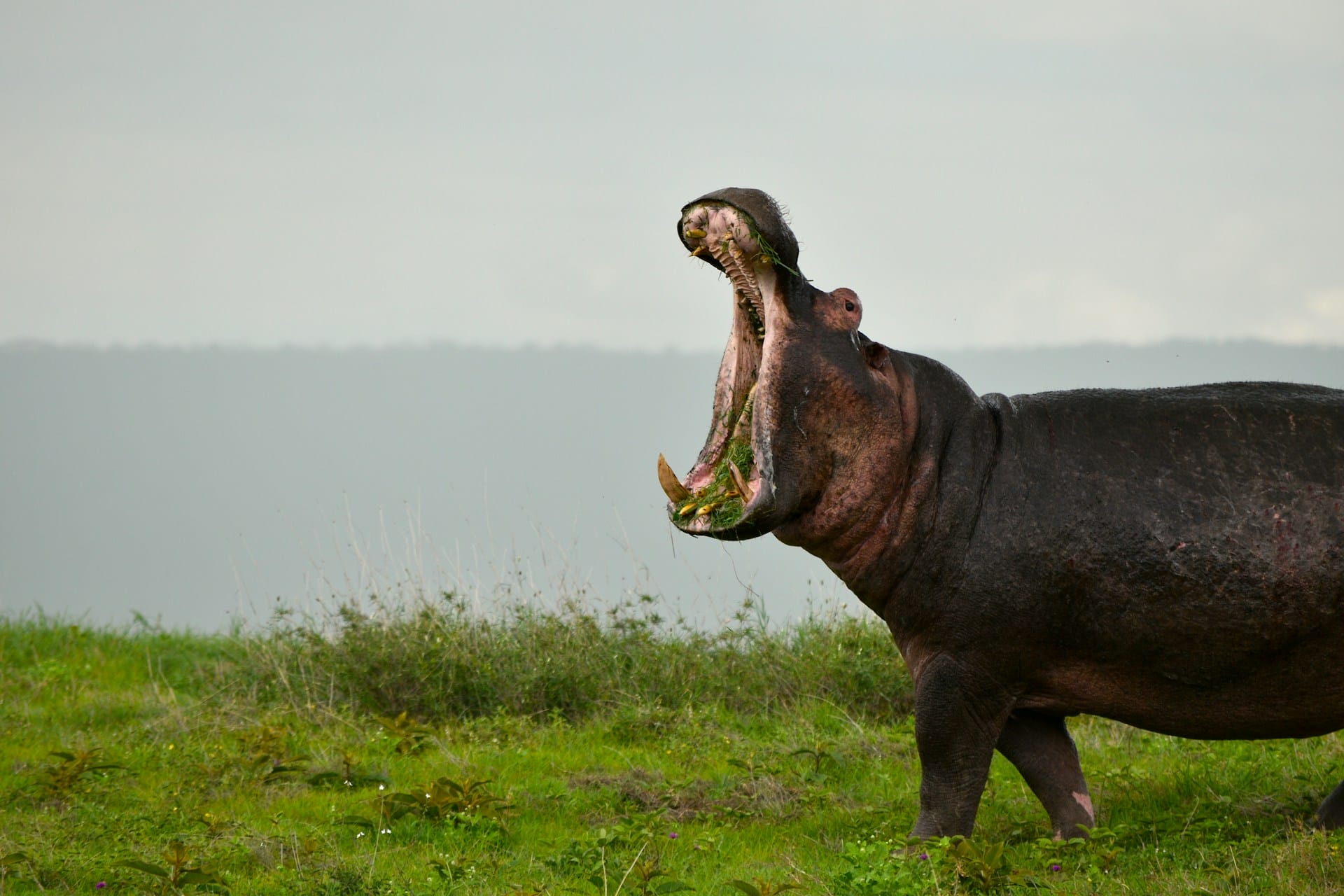
Here’s the thing about hippos: they might be herbivores, but nobody told them to act like it. Those canine teeth? They can grow up to 20 inches long. Twenty. Inches. That’s longer than a standard ruler, and they’re sharp as knives.
And when a hippo decides to open its mouth to show you those teeth, you’re looking at a jaw that can gape 150 to 180 degrees. We’re talking about a four-foot opening, literally wide enough for a small child to stand in (though please, nobody test this theory).
But the really terrifying part? That bite force we mentioned: 1,827 PSI. To put that in perspective, that’s ten times stronger than your bite and powerful enough to snap a canoe in half like a breadstick. I’ve heard stories from guides about hippos biting crocodiles, capsizing boats, and… well, let’s just say you don’t want to be on the receiving end.
Fast? Hippos? You're Kidding, Right?
Wrong! This is where things get really interesting (and scary). Look at a hippo and you’re probably thinking, “Yeah, no way that thing can move fast.” Those stumpy legs, that barrel body, the general vibe of a couch potato…
But here’s the kicker: hippos can charge at speeds up to 30 mph on land. For reference, Usain Bolt’s top speed was 27.33 mph. So unless you’re an Olympic sprinter (and even then), you’re not outrunning an angry hippo. Not even close.
Oh, and here’s another fun fact that blows people’s minds—hippos can’t actually swim. Nope! They’re too dense to float. Instead, they walk, run, or gallop along the riverbed in this sort of slow-motion bounce. It looks almost graceful… until you remember those teeth.
Aggressive? That's Putting It Mildly
This is where hippos really earn their reputation. They’re responsible for an estimated 500 human deaths per year in Africa. That’s more than lions, leopards, buffalo, and crocodiles combined.
Why so aggressive? Well, hippos are incredibly territorial and protective. You’re most likely to have a problem when:
- You get between them and the water (their safety zone)
- You surprise them on land at night while they’re grazing
- You accidentally wander into their territory
- There’s a mother with a calf nearby
- They feel threatened or cornered in any way
The scary part? Hippos don’t give a lot of warning. One second everything seems fine, the next second you’re dealing with four tons of fury moving at you faster than you can run. It’s why experienced safari guides treat them with more respect than they give to lions.
Built Different: The Hippopotamus Body Explained
Hippos are what we call semi-aquatic, which is a fancy way of saying they’ve got the best of both worlds figured out. During the day, they spend up to 16 hours chilling in the water. And by chilling, I mean literally, they’re staying cool in Africa’s brutal heat.
Their whole head design is built for this lifestyle. Eyes, ears, and nostrils all sit on top of their head, periscope-style. This means they can keep almost their entire body underwater while still breathing and keeping watch for threats (mainly crocs, though adult hippos don’t have much to worry about).
When they do submerge completely, their ears and nostrils snap shut automatically, kind of like built-in waterproof seals. They’ve got special membranes that protect their eyes too. And while they can’t breathe underwater (they’re mammals, after all), they can hold their breath for a solid five minutes while walking around on the riverbed.
The Famous "Blood Sweat" That Isn't Actually Blood
Okay, this is one of my favorite hippo facts. You know how hippos sometimes look like they’re sweating blood? That reddish-orange liquid oozing from their skin? Ancient people thought hippos literally sweated blood, which is pretty metal when you think about it.
But the truth is even cooler. Hippos don’t have sweat glands at all. Instead, they secrete this reddish, oily substance that scientists call “blood sweat” just because it’s easier than its technical name. This stuff is basically hippo’s built-in protection system. It works as:
Sunscreen – Blocks harmful UV rays (SPF hippo, if you will)
Moisturizer – Keeps their skin from drying out and cracking
Antibiotic – Helps prevent infections from all those territorial fights
Without this secretion, hippos would be in serious trouble. Their skin is actually surprisingly sensitive for such a tough-looking animal, and the African sun is no joke.
Big, Dense, and Ready to Sink
Let’s talk size for a second. The hippo is the third-largest land mammal, after elephants and white rhinos. A full-grown male typically stretches 11.5 feet long and stands about 5 feet tall at the shoulder. Weight-wise? We’re talking up to 4 tons for the big boys. Females are no lightweights either, though they’re about 30% smaller than males.
But here’s what’s really interesting—despite looking like they’re all blubber, hippos are actually mostly muscle and dense bones. They have relatively little body fat. This density is exactly what allows them to sink and walk underwater so effortlessly. If they were built like seals or whales, they’d just float helplessly at the surface.
A Day (and Night) in the Life
Daytime: Hippo Pool Party!
Hippos are basically the opposite of morning people. As the sun comes up, they head to the water and pretty much stay there until it sets. We’re talking 16 hours of just… hanging out in the river.
But it’s not pure laziness (though it does look incredibly relaxing). They’re in the water to:
- Escape the intense African heat
- Keep their sensitive skin protected from sunburn
Socialize with their pod (yes, that’s what a group of hippos is called—though “bloat” or “herd” also work) - Rest while staying semi-alert
A typical hippo pool might have anywhere from 10 to 200 individuals, though 20-30 is more common. And despite spending all day together, these aren’t exactly cuddly creatures. The males are constantly posturing, maintaining territories, and reminding each other who’s boss.
Nighttime: Dinner Time!
As soon as the sun starts setting, it’s like someone flips a switch. Hippos emerge from the water and head inland to graze. They’ll walk up to 6 miles from their water source, following the same pathways night after night.
These paths become so well-worn that they look like little highways through the bush. And here’s a pro tip if you’re camping in hippo country: never, ever set up camp on one of these paths. Hippos are creatures of habit, and they will absolutely bulldoze through your tent to stay on their route.
Despite their massive size, hippos don’t eat as much as you’d think. They’ll munch down about 80-100 pounds of grass per night—which sounds like a lot until you realize that’s only 1-2% of their body weight. A human eating proportionally would only need about 3-4 pounds of food per day.
Why so little? Well, they spend most of their time in warm water being buoyant, which means they don’t burn many calories. Their digestive system is also incredibly efficient, extracting maximum nutrients through a long fermentation process in their stomach.
And here’s a fun detail: those massive teeth we talked about? They don’t actually use them for eating. The big canines and incisors are purely weapons. When grazing, hippos use their thick, muscular lips to grab grass, then tear it off with a quick jerk of their head. The actual chewing happens with their molars, tucked away in the back.
The Hippopotamus Territorial Drama
Male hippos are all about real estate. A dominant bull will claim a section of river as his territory and defend it for 12 years or more. This isn’t just about having a nice spot to relax—it’s about mating rights.
During the dry season, females congregate in these territories, and that’s when most mating happens. The territorial bulls get first pick, while younger males hang around on the periphery, waiting their turn.
But here’s what’s fascinating: most of this territorial behavior is just for show. When two bulls face off, there’s usually a lot of:
- Dramatic yawning (showing off those massive teeth)
- Loud bellowing and grunting
- Splashing displays
- The infamous “poo flinging” move
Wait, what was that last one? Oh yeah, hippos mark their territory by spinning their tails like propellers while defecating, spraying dung in a wide arc. It’s disgusting. It’s also incredibly effective. When another bull sees (or smells) this display, they get the message: territory occupied.
Real fights do happen, and when they do, they can be fatal. Bulls will slash at each other with those lower canines, aiming for the flanks. Even with their thick skin, these wounds can be deadly. But actual combat is pretty rare—the displays usually work.
Why Hippos Are Secretly Running the Show
Here’s something most people don’t realize: hippos aren’t just living in Africa’s rivers—they’re actively shaping the entire ecosystem. Scientists call them “ecosystem engineers,” which is a fancy way of saying their very presence changes everything around them.
The Underwater Fertilizer Factory
During the day, while hippos are lounging in the water, they’re also… well, there’s no delicate way to say this… they’re pooping. A lot. And this isn’t just waste—it’s liquid gold for the ecosystem.
Hippo dung is absolutely loaded with nutrients, especially nitrogen and phosphorus. When they release it in the water, these nutrients wash downstream and fertilize the entire aquatic ecosystem. This feeds:
- Algae and aquatic plants
- Insect larvae and invertebrates
- Fish populations (which local communities depend on for protein)
- Pretty much everything living in and around the river
Some scientists estimate that hippos are responsible for transferring tons of nutrients from land to water every year. Without them, many African river systems would be far less productive.
But there’s a catch. When rivers don’t flow properly—because of drought, climate change, or dams—this system breaks down. The hippo dung accumulates in stagnant pools, and suddenly those nutrients become a problem. Oxygen levels plummet, toxic algae blooms, and fish die off. It’s a reminder that these systems are all connected.
Landscaping on a Massive Scale
At night, when hippos are grazing, they’re also maintaining the landscape. Their constant trimming keeps grass short around wetlands and prevents overgrowth. Their pathways create channels for other animals to move through dense vegetation.
Weirdly, hippos are like nature’s lawn mowers, keeping certain areas open and accessible. When hippo populations decline, you can actually see the landscape change—vegetation grows denser, pathways disappear, and other species lose access to water sources.
The Conservation Challenge
Let’s talk about the elephant in the room, or rather, the hippo in the river. Hippopotamus populations are declining, and they’ve been listed as vulnerable since 2006.
Current estimates put the global population somewhere between 115,000 and 130,000 individuals. That might sound like a lot, but it’s down significantly from historical numbers, and the trend continues downward.
The main threats? They’re unfortunately all too familiar:
Habitat Loss: As human populations grow, we’re taking over wetlands, damming rivers, and fragmenting hippo habitat. Hippos need specific conditions, deep water for daytime refuge and nearby grasslands for nighttime feeding. When either disappears, so do the hippos.
Poaching: Despite being protected in most countries, hippos are still hunted illegally. Their meat is valuable, and their teeth are sold as ivory. After the elephant ivory ban in 1989, hunting pressure on hippos actually increased as traders looked for alternatives.
Human-Wildlife Conflict: When hippos raid crops (which happens), farmers understandably get angry. Retaliatory killings are common, especially in areas where communities have to coexist with hippos without support or compensation.
Climate Change: Changing rainfall patterns mean changing water availability. Hippos can’t just pick up and move easily—they’re tied to permanent water sources. As droughts become more common and intense, hippos are getting squeezed.
Some Good News (We Need It)
But it’s not all doom and gloom. There are success stories that prove conservation works when we commit to it.
Take Virunga National Park in the Democratic Republic of Congo. In the 1970s, this park was home to about 29,000 hippos. Then came civil conflict, poaching, and chaos. By 2005, fewer than 900 hippos remained. It was devastating.
But then something changed. Better enforcement, community engagement, and dedicated conservation efforts started turning things around. The population is recovering. It’s proof that when we protect hippos and their habitat, they can bounce back.
The Pygmy Hippo Situation
While we’re on conservation, I should mention the common hippo’s smaller cousin. The pygmy hippopotamus is a completely different species found only in West African rainforests. These guys are about the size of a large pig and are mostly solitary forest dwellers.
Their situation is far more dire—they’re classified as endangered, with fewer than 2,500 mature individuals left. Habitat loss from logging and agriculture is hitting them especially hard. If you’ve never heard of pygmy hippos, you’re not alone, and that’s part of the problem. They need attention and resources too.
Safari Safety: Don't Be a Statistic
Alright, real talk time. If you’re heading to Africa and you’ll be anywhere near hippo territory, you need to take this seriously. These aren’t zoo animals behind barriers—they’re wild, powerful, and potentially deadly.
The Golden Rules
DO:
- Keep at least 30 meters (about 100 feet) between you and hippos
- Stay in your vehicle unless your guide explicitly says it’s safe
- Keep noise to a minimum near hippo pools
- Listen to your guide without question, they know what they’re doing
- Be extra careful during dawn and dusk when hippos are moving between water and land
- Give them a clear path to water if you encounter them on land
DON’T:
- Get between a hippo and water, that’s their escape route and they will go through you
- Approach mothers with calves (this should be obvious, but still)
- Camp on worn pathways (those are hippo highways)
- Assume a yawning hippo is tired, that’s a threat display
- Turn your back on a hippo
- Underestimate how fast they can move
Reading Hippo Body Language
If a hippo is:
- Opening its mouth wide: Back off immediately, this is a clear threat
- Grunting or bellowing: They’re agitated and warning you
- Splashing dramatically: Another warning sign
- Staring directly at you: They’ve noticed you and are assessing the threat
- Turning their rear toward you and wiggling their tail: They’re about to spray dung, but also, you’re too close
The safest hippo is one that doesn’t know you’re there. The second safest is one that sees you but doesn’t care because you’re far enough away.
Where to Experience Hippos Safely
If you want to see these incredible animals in their natural habitat (and you should, they’re amazing), here are some of the best spots:
Serengeti National Park, Tanzania: Massive hippo pools where you can watch entire pods interacting. The Retima Hippo Pool is particularly famous.
Okavango Delta, Botswana: The seasonal flooding creates perfect hippo habitat. Seeing them in this pristine wilderness is unforgettable.
Kruger National Park, South Africa: Excellent infrastructure and accessibility, with reliable hippo sightings along rivers.
Queen Elizabeth National Park, Uganda: The Kazinga Channel boat cruise offers some of the best hippo viewing in Africa—just from a safe distance on the water.
Chobe National Park, Botswana: River cruises here put you at eye level with hippos while maintaining safe distance.
Lake Naivasha, Kenya: Easily accessible from Nairobi, though hippo-human conflict is an issue here.
Final Thoughts
Look, I get it. After reading all this, you might be thinking, “Why would I want to see these aggressive, dangerous animals?” But here’s the thing, that’s exactly why hippos are so fascinating.
They’re living contradictions. Herbivores that are more dangerous than carnivores. Animals that live in water but can’t swim. Creatures that look comical but command respect from every other animal in Africa. They’ve survived millions of years by being perfectly adapted to a particular lifestyle.
But they’re also vulnerable. Despite all their power, all their weapons, all their evolutionary success, hippos are losing ground to human activity. And when we lose hippos, we lose so much more, we lose the nutrient cycles they maintain, the landscapes they shape, the fish populations they support.
Understanding hippos, really understanding them, means respecting both their power and their vulnerability. It means appreciating them from a safe distance while advocating for their protection. It means recognizing that these “river horses” aren’t just surviving in Africa’s waters; they’re holding entire ecosystems together.
So whether you’re planning your first safari or just enjoyed learning something new today, remember: hippos deserve our fascination, our respect, and our protection.
Ready to experience Africa’s incredible wildlife firsthand? At Kwezi Safaris, we specialize in creating unforgettable safari experiences that bring you face-to-face with hippos, elephants, lions, and more—all while prioritizing safety and conservation. Our expert guides know exactly how to give you incredible wildlife encounters while respecting these magnificent animals and their habitats.
Recent Articles

03 Sep 2025


29 Aug 2025

29 Aug 2025

26 Aug 2025