As you stand at the top of Baboon Cliff, the Great Rift Valley sprawls dramatically below, and Lake Nakuru National Park demands your attention with a view that simply takes your breath away. The lake shimmers like liquid mercury, its shores exploding into vibrant pink as thousands of flamingos gather, creating dynamic living carpets that pulse with their continuous feeding and preening. In the background, acacia woodlands rise steeply along the escarpment, while a Rothschild’s giraffe—one of the rarest subspecies on Earth—browses peacefully in the foreground, utterly unfazed by your amazement.
This is Lake Nakuru, a compact 188-square-kilometer jewel in Kenya’s Great Rift Valley crown, where conservation success stories walk on four legs, where pink isn’t just a color but a living phenomenon, and where you can witness more biodiversity in a single afternoon than many parks reveal in a week.
The Pink Phenomenon: When Lakes Blush
The Lake Nakuru flamingos create one of nature’s most spectacular wildlife gatherings. At peak times, up to two million lesser and greater flamingos transform the shallow alkaline lake into what appears to be a vast pink carpet—a living artwork visible from space, constantly reshaping itself as birds move, feed, and take flight in coordinated masses that defy comprehension.
But here’s what makes this phenomenon even more remarkable: it’s entirely accidental from the birds’ perspective. They’re not gathering to impress tourists or create photographic opportunities. They’re simply responding to ecological imperatives perfected over millions of years.
The lake’s high alkalinity—with pH levels reaching 10.5, roughly equivalent to household ammonia—creates conditions inhospitable to most life. But certain blue-green algae thrive in these harsh waters, blooming in such abundance that they turn the lake greenish. Lesser flamingos possess specialized beaks functioning like precision filters, allowing them to strain these microscopic algae from the water. A single bird can filter thousands of liters daily, consuming enough algae to maintain their distinctive pink coloration—the pigments in their food literally coloring their feathers from the inside out.
Greater flamingos employ different feeding strategies, using their beaks to probe mud for small crustaceans, insect larvae, and mollusks. Watching both species feeding together reveals elegant choreography: hundreds of birds moving in synchronized sweeps across shallow water, heads submerged, creating ripples that spread across the lake in geometric patterns.
When something startles the flock—a fish eagle passing overhead, perhaps, or sudden movement on shore—thousands of flamingos simultaneously take flight in an explosion of pink wings that transforms the sky itself. The sound alone—thousands of wings beating, thousands of voices calling—creates a sensory experience that recordings can’t capture and words struggle to convey.
Rhino Sanctuary: Conservation’s Success Story
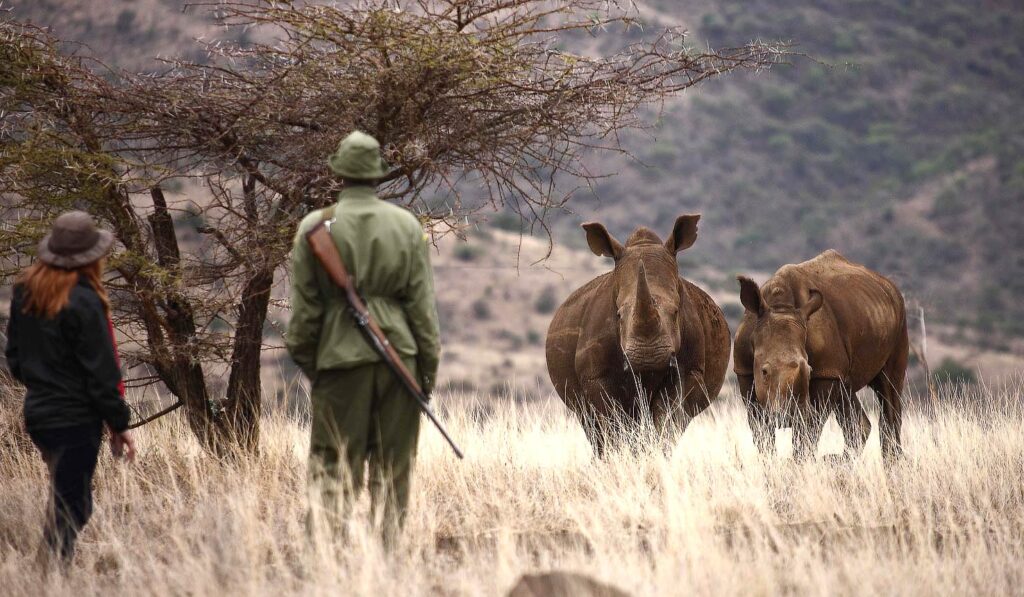
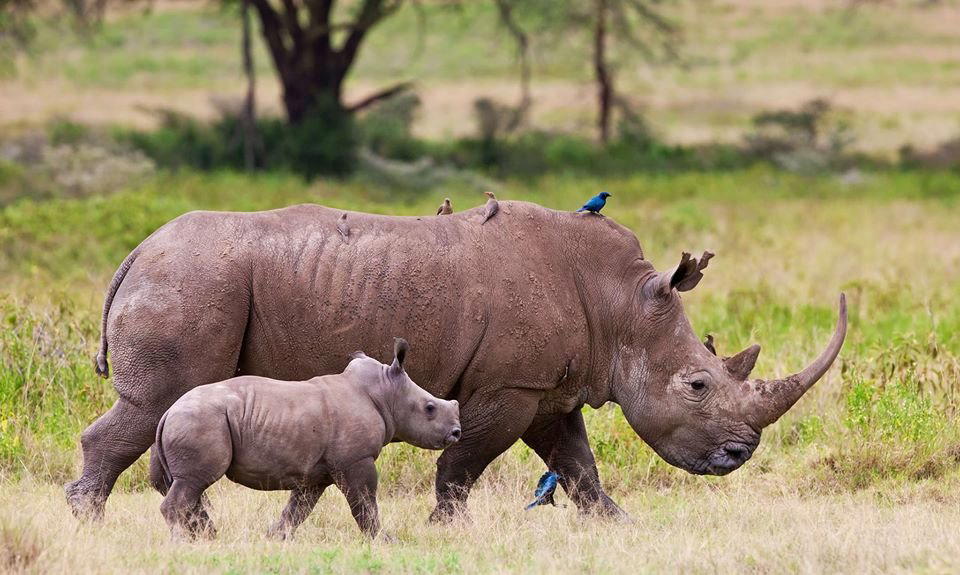
While flamingos garner the headlines, Lake Nakuru National Park deserves equal celebration as one of Kenya’s most successful rhino sanctuaries. The park protects significant populations of both black and white rhinos—a distinction few places can claim—making it among the best locations in Kenya for virtually guaranteed rhino sightings.
The rhino story here represents conservation at its most effective. As Kenya’s rhino populations plummeted catastrophically in the 1970s-80s due to rampant poaching, Lake Nakuru became a critical refuge. The park’s relatively compact size enabled effective fence construction and intensive protection impossible in larger wilderness areas. Round-the-clock armed patrols, sophisticated monitoring systems, and community engagement created the security allowing rhino populations to not just survive but thrive.
Today, encountering both rhino species during a single game drive proves common. The differences between them become immediately apparent once you know what to observe: white rhinos (the name derives from the Afrikaans “wijd” meaning wide, describing their broad, square lips) graze peacefully, their wide mouths perfectly adapted for consuming short grass. Black rhinos browse instead, their pointed, prehensile upper lips designed for selecting specific leaves, shoots, and branches from bushes and small trees.
Watching rhinos in Lake Nakuru creates poignant moments. These prehistoric creatures—unchanged for millions of years, survivors of ice ages and continental drift—came within a whisper of extinction purely due to human greed for their horns. Every living individual represents conservation victory and reminder of what we nearly lost forever.
Rothschild’s Giraffe: The Gentle Giants
Lake Nakuru National Park serves as a crucial sanctuary for Rothschild’s giraffes—one of the world’s most endangered giraffe subspecies. Distinguished by their distinctively clean white “stockings” extending above the knees (other subspecies have patterns extending to their hooves), these elegant creatures were nearly extinct in Kenya by the 1990s.
Conservation translocations brought Rothschild’s giraffes to Lake Nakuru, where the protected environment and abundant acacia browse enabled populations to flourish. Today, the park harbors a thriving population, often visible browsing near the main roads, their impossibly long necks creating living sculptures against dramatic rift valley backdrops.
Watching Rothschild’s giraffes move—that physics-defying gait where both legs on one side move together—creates meditative viewing. They browse peacefully, using 18-inch tongues to strip acacia leaves while avoiding the vicious thorns, occasionally pausing to regard safari vehicles with those impossibly long-lashed eyes that make humans feel inadequate about their own lashes.
Africa’s Largest Euphorbia Forest
The eastern section of Lake Nakuru protects what’s believed to be Africa’s largest euphorbia forest—a striking landscape dominated by these distinctive candelabra-shaped succulents rising like giant cacti from rocky hillsides. The euphorbia forest creates an otherworldly atmosphere, its repetitive vertical forms creating almost architectural landscapes that feel vaguely Dr. Seuss-like in their geometry.
These succulent trees serve crucial ecological functions beyond aesthetics. Their toxic latex deters most browsing animals (though dik-diks somehow tolerate it), their structure provides bird nesting sites, and their seasonal flowering attracts pollinators. Leopards occasionally utilize euphorbia branches as daytime refuges, their spotted coats blending remarkably well with the mottled bark despite the trees’ vertical architecture.
Predators and Prey: The Complete Cast
Beyond rhinos, giraffes, and flamingos, Lake Nakuru National Park Kenya supports impressive general wildlife diversity. Lions patrol the park, their prides sometimes visible lounging beneath acacia shade or atop rocky outcrops surveying their domains. Leopards prove more elusive but regular, particularly in the euphorbia forest and along the escarpment.
Buffalo herds graze the grasslands, occasionally numbering hundreds. Zebras stripe the plains in classic safari imagery. Waterbucks—those distinctive antelopes with white “toilet seats” on their rumps—frequent areas near the lake. Warthogs trot comically with tails erect. And baboon troops create constant entertainment through their complex social interactions and occasional thefts from unwary picnickers.
Avian Paradise: 450+ Species
While flamingos dominate attention, Lake Nakuru’s 450+ recorded bird species create ornithological paradise. African fish eagles perch prominently, their distinctive calls echoing across the lake. Goliath herons—standing over a meter tall—stalk the shallows. Pelicans fish cooperatively. And countless others—cormorants, ducks, geese, plovers, and during European winter, numerous migrant species—exploit the diverse habitats.
The acacia woodlands harbor forest specialists, grasslands support larks and bustards, and the euphorbia forest provides nesting for unique species. Serious birders can easily record 100+ species during full-day visits.
Scenic Viewpoints: Perspectives on Paradise
Several viewpoints around Lake Nakuru offer spectacular panoramas: Baboon Cliff provides the classic overview of lake and park, Lion Hill offers sunset vistas, and Out of Africa Lookout (named for scenes filmed nearby) creates romantic prospects across the rift valley.
Your Accessible Paradise Awaits
Lake Nakuru National Park proves that size doesn’t determine significance. Just 2.5 hours from Nairobi, this compact gem delivers experiences matching much larger parks—guaranteed rhino sightings, rare giraffes, spectacular flamingo gatherings, and comprehensive wildlife viewing in timeframes accommodating even short visits.
Your pink paradise in the Great Rift Valley awaits.