Gishwati-Mukura National Park: Rwanda’s Forest Rising from the Ashes
There’s a particular kind of hope that exists only in places where nature demonstrates its remarkable capacity for healing—where forests once devastated by human exploitation slowly reclaim their former glory, where wildlife returns to landscapes they’d abandoned, where communities that once viewed forests as resources to extract now become their most passionate protectors. In Gishwati-Mukura National Park, Rwanda’s youngest protected area, this hope isn’t abstract concept but living reality unfolding across 34 square kilometers of montane rainforest that refused to die.
Stand at the forest edge where restoration plantings from just a decade ago now tower overhead, their canopy thick enough to filter sunlight into cathedral-like green glow. Listen as golden monkeys crash through branches overhead, their presence testament to habitat recovery creating viable homes for species that had nearly vanished from these hills. And understand that you’re witnessing something profoundly important: conservation not as preservation of pristine wilderness but as active restoration of degraded landscapes—proof that it’s never too late to repair our relationship with nature.
From Devastation to UNESCO Recognition
The Gishwati-Mukura story begins in tragedy. By the early 2000s, what had once been extensive montane rainforest covering Rwanda’s western highlands had shrunk to tiny remnants—the Gishwati and Mukura fragments totaling barely 1,000 hectares. Decades of deforestation driven by agriculture, logging, mining, and the chaos surrounding Rwanda’s 1994 genocide had reduced magnificent forests to isolated patches surrounded by degraded lands.
The forests’ destruction created cascading problems: soil erosion accelerated without forest cover, water sources dried up as forests no longer intercepted moisture, wildlife populations plummeted as habitat fragmented, and local communities faced increasing hardship as the ecosystem services forests provided—clean water, fertile soil, climate regulation—disappeared.
But Rwanda’s government, local communities, and conservation organizations chose restoration over resignation. Beginning in 2008, intensive reforestation efforts commenced—planting native tree species, removing invasive plants, protecting remaining forest fragments, and creating wildlife corridors connecting Gishwati and Mukura. In 2015, the fragments were designated as national parks. And in 2020—just five years later—UNESCO designated Gishwati-Mukura a Biosphere Reserve, recognizing the remarkable recovery and the innovative community-based conservation model driving it.
This trajectory—from near-total degradation to UNESCO recognition within a single decade—represents one of Africa’s most inspiring conservation success stories.
Chimpanzees: The Forest’s Comeback Kids
The Gishwati-Mukura chimpanzees symbolize the park’s recovery most powerfully. When habitat degradation was worst, the chimpanzee population crashed to perhaps 20 individuals clinging to existence in Gishwati’s remaining forest. These intelligent apes—humanity’s closest living relatives sharing 98.7% of our DNA—faced potential local extinction as their forest home vanished.
Today, thanks to protection and habitat restoration, the population has stabilized and shows signs of recovery. While numbers remain modest compared to Uganda’s Kibale Forest or Tanzania’s Gombe, the mere fact that chimpanzees persist—and reproduce—in Gishwati-Mukura represents conservation victory against overwhelming odds.
Chimpanzee tracking here differs fundamentally from experiences in larger, more established parks. The groups are smaller, habituation is still progressing, and sightings require more patience. But these challenges enhance rather than diminish the experience. When you finally glimpse chimps feeding in fruiting trees, hear their distinctive pant-hoot calls echoing through the forest, or observe mothers tenderly caring for infants, you’re witnessing not just wildlife but resilience—creatures that survived humanity’s worst and now cautiously recover as we attempt to repair the damage.
Golden Monkeys and Primate Diversity
Beyond chimpanzees, Gishwati-Mukura National Park Rwanda harbors impressive primate diversity. The golden monkeys—those strikingly beautiful primates with their golden-orange body fur contrasting against black limbs—inhabit the bamboo forests, their acrobatic movements through the canopy providing entertainment rivaling any wildlife documentary.
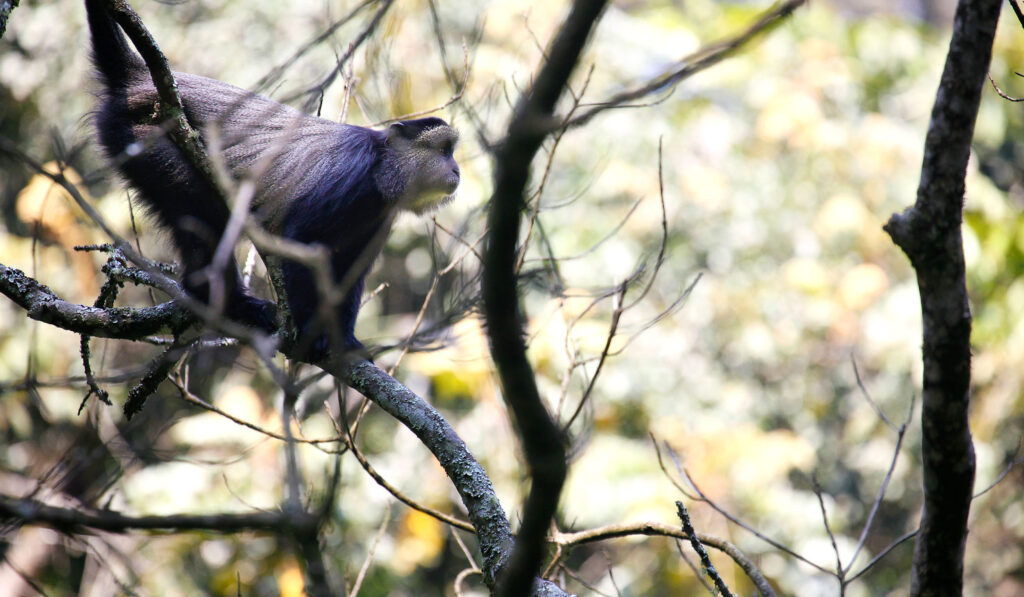
L’Hoest’s monkeys, blue monkeys, and black-and-white colobus complete the primate roster, their presence indicating healthy forest recovery creating viable habitat for species with specific ecological requirements. Each primate species occupies different forest niches—some preferring high canopy, others mid-level branches, still others ground-level foraging—their diversity demonstrating ecosystem complexity recovering alongside habitat area.
Avian Richness: 230+ Species in a Tiny Park
That Gishwati-Mukura supports over 230 bird species in Gishwati alone (160+ in smaller Mukura) proves remarkable given the park’s modest size. This avian diversity results from the park’s position within the Albertine Rift—a biodiversity hotspot harboring numerous endemic species found nowhere else on Earth.
Approximately 20 Albertine Rift endemic species inhabit the park, including the spectacular Rwenzori turaco with its iridescent green and blue plumage, handsome francolin, Grauer’s rush warbler, and numerous others that attract serious birders seeking these range-restricted specialties.
The forest stratification creates distinct avian zones: canopy specialists rarely descending to lower levels, understory species avoiding high branches, and forest-edge birds exploiting the transitional habitats where forest meets grassland. Bamboo zones harbor different species than hardwood forests, and the streams cutting through valleys support yet another assemblage.
For birders, Gishwati-Mukura offers exceptional diversity-to-area ratios—the ability to record 100+ species during single-day visits within a compact area requiring minimal walking between habitats.
Community Conservation: When People Become Forest Champions
What truly distinguishes Gishwati-Mukura from traditional “fortress conservation” approaches is the central role local communities play in restoration and protection. Many people now employed as park rangers, guides, and restoration workers previously depended on forest resources—harvesting timber, expanding agriculture into forest margins, extracting medicinal plants unsustainably.
The transition from resource extraction to conservation stewardship didn’t happen magically. It required demonstrating that restored forests provide greater long-term benefits than degraded landscapes: improved water quality and availability, reduced soil erosion protecting farmland, tourism revenue creating employment, and ecosystem services like climate regulation and pollination supporting agriculture.
Cultural tourism programs connect visitors with communities surrounding the park. Learn about traditional forest uses—medicinal plants, honey gathering, spiritual practices—that existed sustainably for generations before population pressure and poverty drove unsustainable exploitation. Witness the pride community members express in the forest’s recovery, their role in that recovery, and their commitment to ensuring restoration continues.
These encounters transform abstract conservation into human stories—former loggers now planting trees, communities protecting watersheds feeding their wells, children who will inherit healthier landscapes than their parents knew.
The UNESCO Biosphere Reserve Designation
The 2020 UNESCO Biosphere Reserve designation recognized Gishwati-Mukura as more than wildlife refuge—it’s a model for sustainable development balancing conservation, community livelihoods, and restoration. Biosphere Reserves represent UNESCO’s vision for how humans and nature can thrive together, making this designation particularly appropriate for a park literally born from restoration efforts.
The designation brings international recognition, potential funding opportunities, knowledge exchange with other Biosphere Reserves globally, and validation that Rwanda’s restoration approach deserves replication elsewhere.
Activities: Experiencing the Recovery
Gishwati-Mukura activities currently include guided nature hikes revealing forest ecology and restoration techniques, chimpanzee and primate tracking offering wildlife encounters supporting conservation through permit fees, birdwatching exploiting the exceptional avian diversity, and community cultural visits providing authentic engagement.
The park’s tourism infrastructure continues developing—trails are being improved, guides receive ongoing training, and visitor facilities are gradually expanding. This development phase means Gishwati-Mukura offers authentic, off-the-beaten-path experiences for visitors comfortable with modest facilities and willing to support nascent conservation-based tourism.
Your Restoration Story Awaits
Gishwati-Mukura National Park won’t rival Nyungwe’s ancient forests or Volcanoes’ gorilla encounters for established infrastructure or guaranteed sightings. But it offers something potentially more valuable: witness to nature’s resilience, proof that restoration works, and the satisfaction of supporting conservation at its most crucial early stages.
This is Rwanda’s forest rising from the ashes—where every tree planted, every chimpanzee birth, every tourist visit contributes to recovery still unfolding.
Your restoration journey awaits in Gishwati-Mukura’s recovering forests.