Nyungwe Forest National Park: Rwanda’s Ancient Rainforest & Primate Paradise
Cascading across the mountainous spine of southwestern Rwanda, Nyungwe Forest National Park protects one of Africa’s oldest and most biodiverse montane rainforests, an ancient ecosystem that has persisted for millions of years, surviving climatic upheavals that destroyed most African forests. Covering 1,019 square kilometers of pristine wilderness spanning elevations from 1,600 to 2,950 meters, this UNESCO World Heritage Site candidate represents a conservation treasure of global significance, harboring species found nowhere else on Earth while performing critical ecological functions sustaining Rwanda’s environment and economy.
The Nyungwe Forest National Park Rwanda experience delivers what adventurous travelers and serious naturalists seek: intimate encounters with 13 primate species, including chimpanzees, the continent’s highest concentration of Albertine Rift endemic birds, the spectacular Canopy Walkway suspended 70 meters above the forest floor, and immersion in pristine rainforest where biodiversity rivals the Amazon. This is Rwanda beyond the famous mountain gorillas, a different but equally compelling wilderness where ancient forests reveal nature’s extraordinary creativity.
Ancient Rainforest: Millions of Years of Evolution
Nyungwe Forest ranks among Africa’s oldest continuously existing rainforests, with some estimates suggesting the ecosystem has persisted largely unchanged for over 50 million years. This extraordinary antiquity enabled evolutionary processes creating the exceptional biodiversity characterizing the park today.
During ice ages, when global cooling dramatically reduced tropical forests, Nyungwe persisted as a forest refugium, an isolated forest patch where species survived while surrounding areas transformed to grassland. These refugia became biodiversity engines where isolated populations evolved into distinct species, creating the endemic richness that makes Nyungwe scientifically priceless.
The forest’s physical character reflects its mountainous setting: steep slopes carpeted in dense vegetation, deep valleys carved by countless streams, rocky ridges offering spectacular viewpoints, seasonal waterfalls plunging over volcanic rock formations, and perpetual mist creating the moisture sustaining this lush ecosystem. The landscape’s dramatic topography combined with elevation gradients creates habitat diversity supporting specialized species assemblages adapted to specific conditions.
Critical Water Source: Rwanda’s Natural Reservoir
Beyond biodiversity conservation, Nyungwe National Park performs essential hydrological functions sustaining Rwanda’s environment and economy. The park acts as Rwanda’s primary water catchment, over 70% of the country’s water originates from Nyungwe’s forests, feeding rivers, lakes, and underground aquifers supporting agriculture, hydroelectric power generation, and urban water supplies.
The forest’s complex hydrology creates a remarkable geographic distinction: Nyungwe’s ridges form the Congo-Nile watershed divide. Rivers flowing west eventually join the Congo River system draining to the Atlantic Ocean, while eastward-flowing waters feed the Nile River ultimately reaching the Mediterranean Sea thousands of kilometers north. Standing on certain ridges, you can literally observe water flowing toward two different oceans.
This watershed function makes forest conservation economically essential beyond tourism revenue—the forests’ water regulation, erosion prevention, and climate moderation provide ecosystem services worth millions annually, creating powerful economic arguments for protection complementing biodiversity conservation motivations.
Exceptional Primate Diversity: Thirteen Species
Nyungwe Forest harbors East Africa’s highest primate diversity with thirteen recorded species, a concentration rivaled by few African forests. This primate richness results from habitat diversity, ancient forest continuity, and the Albertine Rift’s role as evolutionary hotspot.
Chimpanzee Communities: The Flagship Experience
Chimpanzee trekking Nyungwe represents the park’s premier wildlife activity. Approximately 500 chimpanzees inhabit Nyungwe’s forests across multiple communities, with two groups habituated for tourism—enabling intimate observation of humanity’s closest living relatives sharing 98.7% of our DNA.
The Nyungwe chimpanzee trek begins early morning when these intelligent apes vocalize loudly—distinctive pant-hoot calls echoing through the canopy as dispersed family members communicate locations. Expert trackers locate communities through vocalizations and previous day’s nest sites, then guide visitors through sometimes challenging terrain for allocated viewing hours.
Observing habituated chimpanzees proves profoundly moving. Watch complex social interactions revealing intelligence, politics, and emotions immediately recognizable to human observers: dominant males displaying impressive power, mothers tenderly caring for infants, juveniles playing energetically, and tool use demonstrating remarkable problem-solving abilities—fashioning sticks to fish termites from mounds, using leaves as sponges to drink water from tree holes, and employing rocks to crack nuts.
The forest setting creates different chimpanzee viewing character compared to Uganda’s Kibale Forest. Nyungwe’s steep terrain and dense vegetation sometimes challenge observation, but when chimps feed in fruiting trees or rest in visible locations, the encounters prove magical.
Colobus Monkey Mega-Troops
Nyungwe harbors the largest Angolan colobus monkey troops recorded anywhere, sometimes exceeding 300 individuals creating spectacular wildlife phenomena. These striking black-and-white primates move through the canopy in massive aggregations, their long white tails flowing behind as they leap acrobatically between trees.
Encountering these mega-troops ranks among Nyungwe’s most memorable experiences. The sound of hundreds of colobus crashing through canopy, their collective vocalizations, and the visual spectacle of so many primates moving together creates wildlife theater rivaling better-known African spectacles.
Additional Primate Species
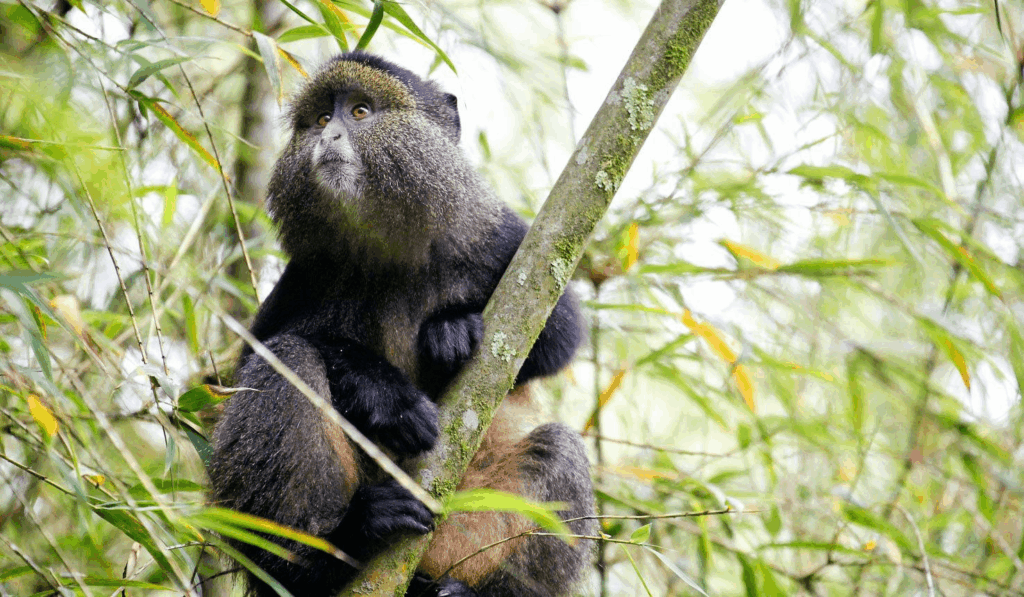
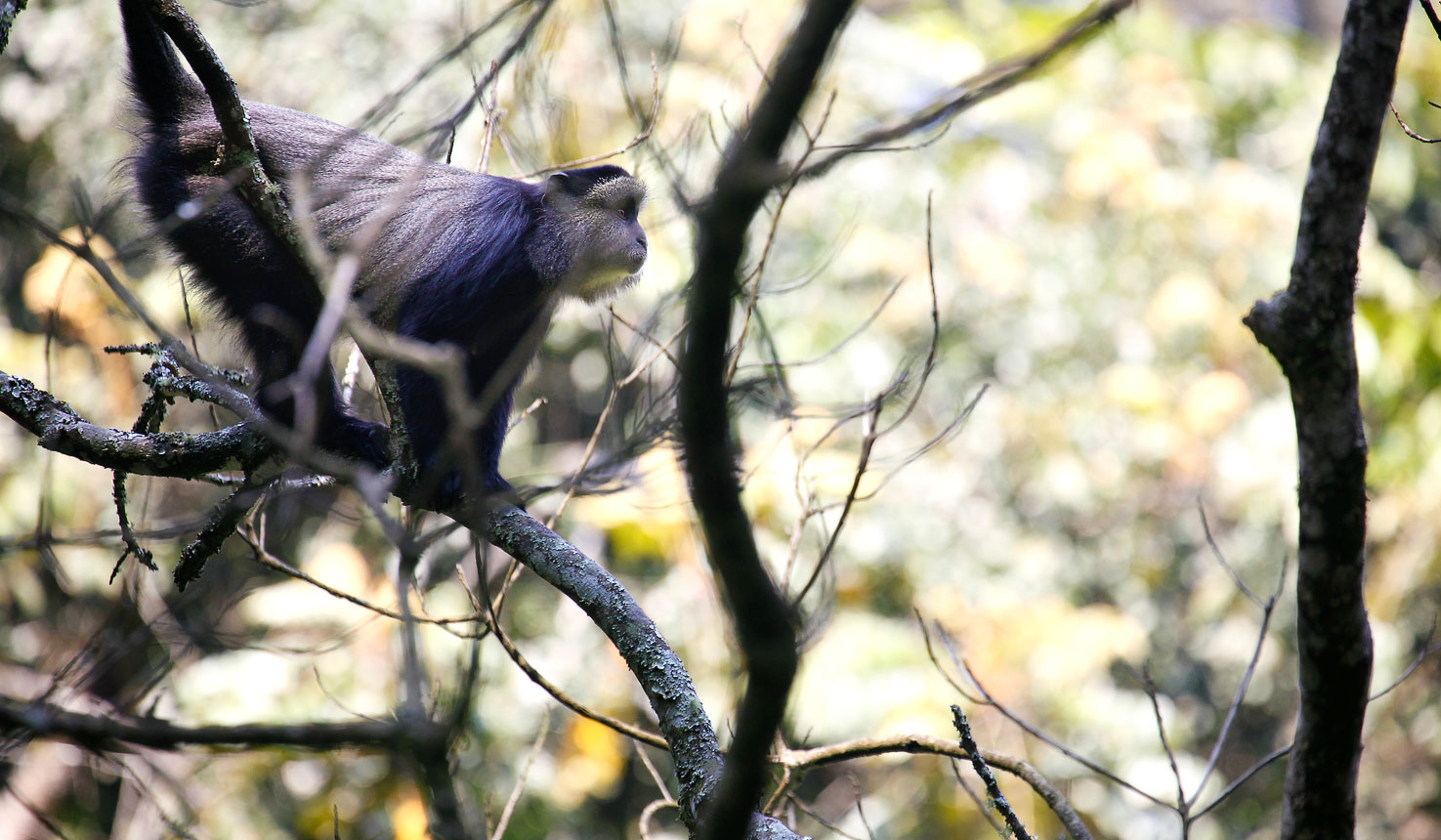
Beyond chimpanzees and Angolan colobus, Nyungwe protects L’Hoest’s monkeys, blue monkeys, red-tailed monkeys, silver monkeys, olive baboons, grey-cheeked mangabeys, golden monkeys (rare sightings), and several nocturnal prosimians including pottos and galagos (bushbabies).
This diversity enables remarkable primate viewing during single visits—encountering five or six species during forest walks proves common, while dedicated primate enthusiasts can record ten or more species with patience and expert guides.
The Canopy Walkway: East Africa’s Highest
The Nyungwe Canopy Walkway represents one of Nyungwe Forest National Park’s most exhilarating attractions and East Africa’s only canopy walkway. This 160-meter suspension bridge spans a forested valley 70 meters (230 feet) above the ground, providing breathtaking perspectives impossible from forest floor.
Walking the gently swaying bridge delivers multiple sensory thrills: the height creating adrenaline rushes for those nervous about exposure, panoramic forest canopy views revealing the three-dimensional structure invisible from below, and unique wildlife observation opportunities as you enter the realm of canopy-dwelling birds, primates, and other species rarely descending to ground level.
The walkway’s positioning along popular hiking trails means most visitors incorporate this experience into broader forest explorations, creating comprehensive experiences combining ground-level and aerial forest perspectives.
Exceptional Birdwatching: Albertine Rift Endemics
Nyungwe National Park ranks among Africa’s premier birding destinations with over 310 recorded species—including 27 Albertine Rift endemics found nowhere else globally. These endemic species evolved in isolation within the Albertine Rift’s montane forests, creating the region’s extraordinary avian biodiversity.
Target endemic species include Grauer’s rush warbler, Rwenzori turaco, red-collared mountain babbler, handsome francolin, Archer’s robin-chat, and numerous others representing ornithological treasures attracting serious birders worldwide.
Beyond endemics, the forest supports spectacular diversity: great blue turacos displaying iridescent plumage, various sunbird species, numerous greenbuls and forest robins, and during European winter, countless migrant species escaping northern hemisphere cold.
The elevation gradients create distinct avian zones—different species assemblages at various altitudes—meaning comprehensive birding requires exploring multiple forest areas across the park’s elevation range.
Diverse Hiking Trails and Waterfalls
Nyungwe Forest offers over thirteen established hiking trails ranging from short 2-3 hour walks to challenging full-day treks crossing the park:
Igishigishigi Trail: Leads to the Canopy Walkway through beautiful forest showcasing diverse vegetation and regular primate sightings.
Kamiranzovu Trail: Explores swampy areas where forest elephants (extremely rare but present) occasionally appear, showcasing wetland ecosystems within the broader rainforest.
Karamba Trail: Follows ridges offering spectacular views across forested valleys toward Lake Kivu and, on clear days, distant volcanoes.
Waterfall Trails: Multiple trails visit seasonal and permanent waterfalls plunging over volcanic rock—creating scenic destinations and photographic opportunities.
Bigugu Trail: Summits Mount Bigugu (2,950m)—Nyungwe’s highest peak—revealing panoramic views rewarding the strenuous climb.
These trails reveal forest ecology, smaller species invisible during primate-focused treks, medicinal plants, and the intricate relationships sustaining this ancient ecosystem.
Conservation and Community Impact
Nyungwe Forest National Park demonstrates conservation delivering both biodiversity protection and community benefits. Tourism revenue funds anti-poaching patrols, habitat restoration, and research programs while supporting nearby communities through employment, infrastructure development, and revenue sharing.
Community conservation initiatives, beekeeping cooperatives producing forest honey, tea cooperatives around park boundaries, and cultural tourism supporting traditional crafts, create economic alternatives to forest resource exploitation.
Your ancient rainforest adventure in Rwanda’s primate paradise awaits.