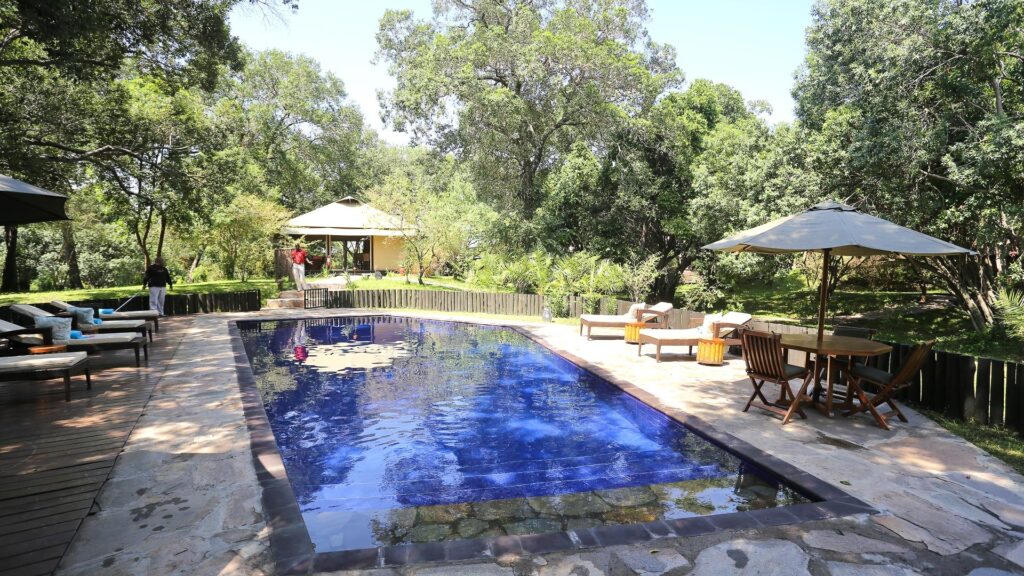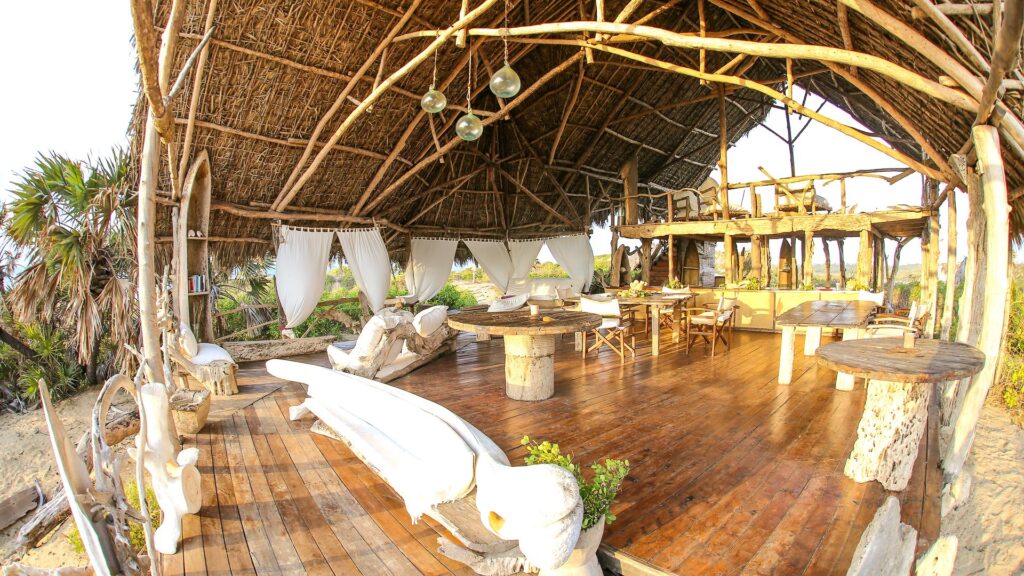
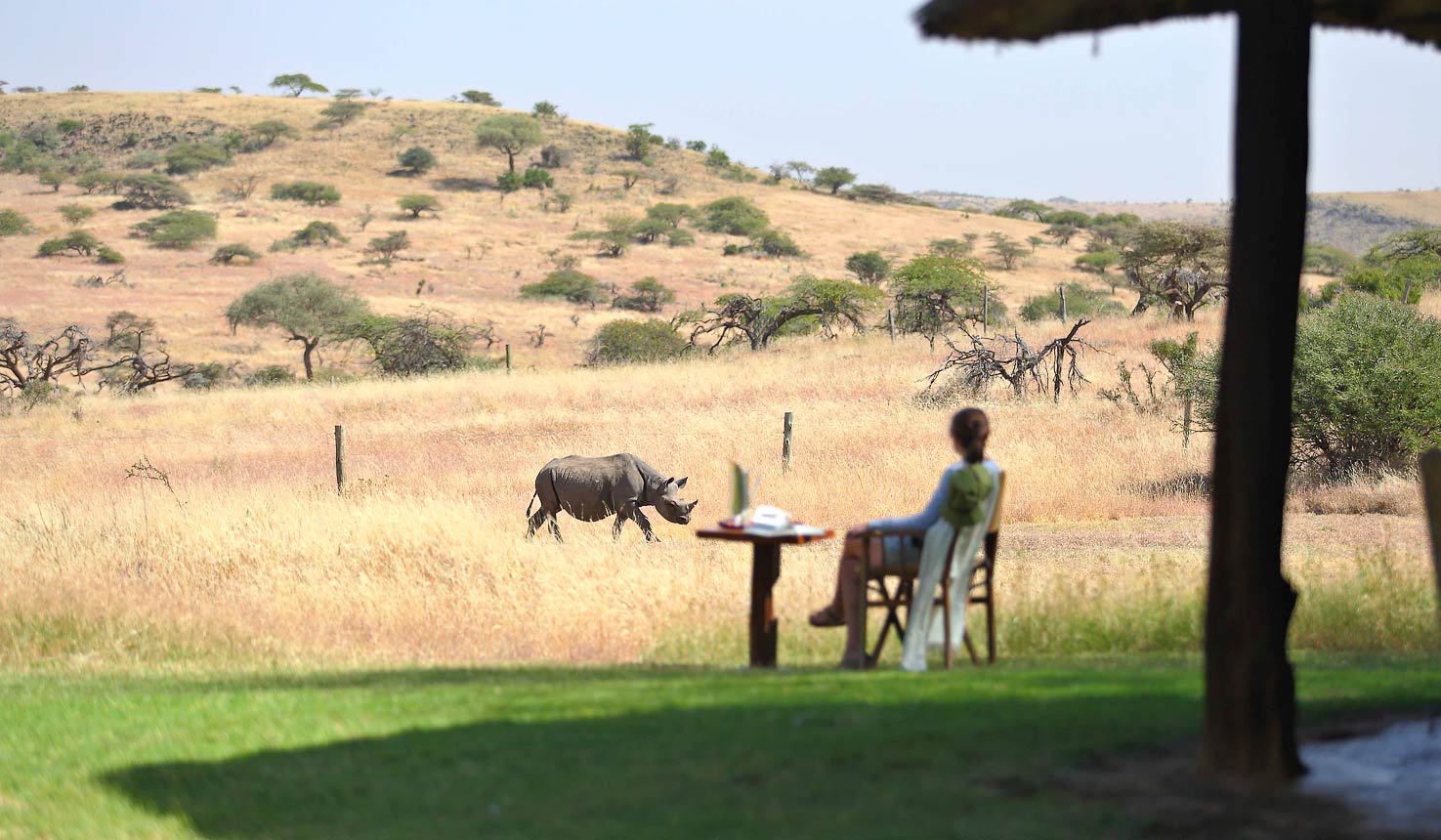
Kifaru House sits on a ridge in the heart of Lewa Wildlife Conservancy: five thatched cottages above a waterhole where black rhinos come to drink in the late afternoon and Grevy’s zebra file past the pool. Kifaru is the Swahili word for rhino, and the land around this house lives up to the name. On clear mornings, Mount Kenya fills the southern skyline. To the north, the plains fall away toward Samburu country.
It is one of the most personal places to stay in Kenya. With room for about 12 guests, it feels less like a lodge than a friend’s home in the bush, one that happens to come with a chef, an infinity pool and some of Africa’s most closely protected wildlife at the edge of the lawn.
This guide covers what Kifaru House is really like, what a stay costs in 2026, when to go, how to get there and how we build it into a private Kenya safari.
Field note from George Nchau: Among the best things our guests mention the most while staying at Kifaru House is that rhinos usually stroll around the cottages and are not hard to spot, considering they are one of the shyest wild animal.
Why Kifaru House is worth the journey
Lewa is not a national park. It began in 1983 as a rhino sanctuary on a cattle ranch and grew into a 62,000-acre conservancy, inscribed as part of the Mount Kenya UNESCO World Heritage Site in 2013. Its boundary with neighbouring Borana is unfenced, so rhinos roam across 93,000 acres of shared range.
The numbers explain why serious wildlife travellers make the trip. The Lewa-Borana landscape held 273 rhinos at the end of 2024, 130 black and 143 white, and Lewa has recorded no rhino poaching since 2019. It also protects the world’s largest resident population of endangered Grevy’s zebra, alongside reticulated giraffe, gerenuk, Beisa oryx, elephant, buffalo, lion, leopard and cheetah. All of the Big Five live here.
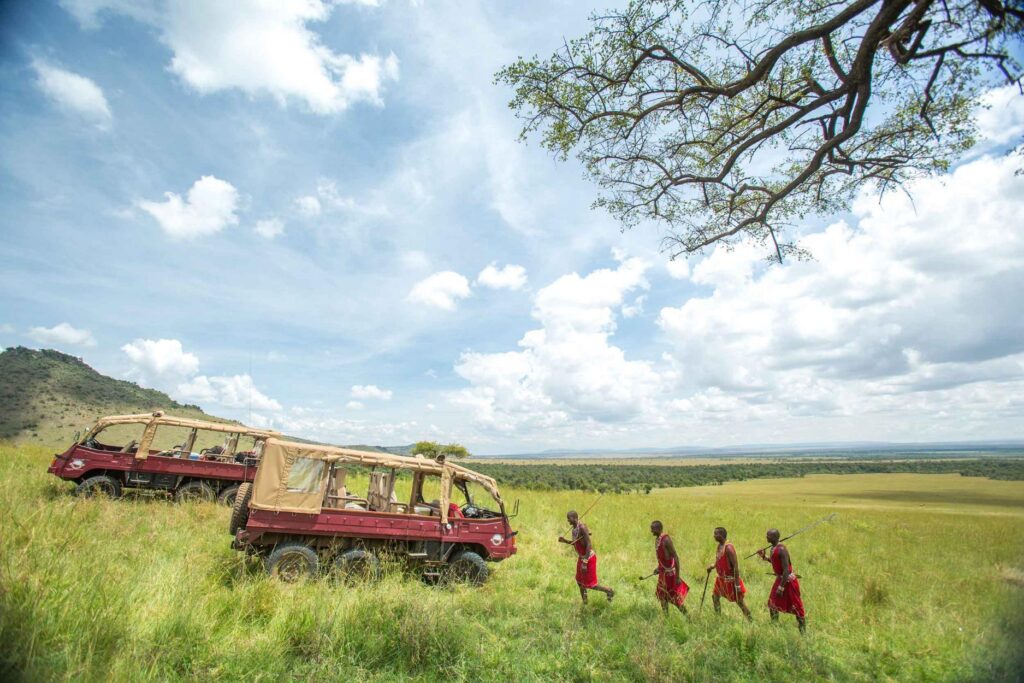
What that means on the ground is simple. There are few vehicles, rangers know individual animals by name, and you can do things a national reserve does not allow: night drives, guided walks and tracking on horseback. You are not one of forty vehicles circling a sighting. On a quiet morning, you may be the only one.
Inside the house: cottages, rooms and the main lodge
Life at Kifaru House centres on the main house: a sitting room and bar, a dining room, a wide terrace and an infinity pool looking down to the waterhole. Breakfast is usually served on the terrace, often with impala grazing below and, if you are lucky, a rhino working its way to water.
The five cottages are spread across lawns under old shade trees. Each has its own entrance and veranda:
- Four cottages each have a king-size four-poster bed and a large en-suite bathroom with twin basins. One adds a Victorian-style bath and an outdoor shower.
- One family cottage has two separate en-suite bedrooms, a double and a twin, each with its own entrance. It sleeps up to five: three adults and two children.
That gives six bedrooms in all. For years the house was booked only on an exclusive-use basis. Since joining the Elewana Collection it also takes individual bookings, so a couple can reserve a single cottage and share the house with a handful of other guests.
Families and groups of friends can still take the whole property, and that is when Kifaru House is at its best. You get your own chef, your own guide, and meal times set around your day rather than a schedule. For a multi-generational family or a milestone birthday, there are few better places in East Africa.
How your days unfold at Kifaru House
A day usually begins before sunrise with coffee on the veranda, then a morning drive while the light is low and the predators are still moving. You return for a late breakfast and spend the heat of the day by the pool or with a book. In the afternoon, you head out again and finish with sundowners on a rocky outcrop as the snow on Mount Kenya catches the last light.
Activities on Lewa include:
- Game drives by day, with black and white rhino and Grevy’s zebra as the signature sightings
- Night drives, your best chance of aardvark, striped hyena, genet and leopard
- Guided walks with an armed ranger, reading tracks and learning the smaller life of the plains
- Horse riding across the conservancy among giraffe and zebra, charged separately
- Camel rides, a gentle option that children love
- Time with Lewa’s anti-poaching tracker dog unit, a working team that has helped keep the conservancy’s rhino safe
- Community visits to neighbouring homesteads and Lewa’s schools and conservation projects
Horse riding is worth every dollar. Seeing a rhino from the saddle, with no engine between you and the animal, is one of the most moving encounters a Kenya safari can offer, and Lewa is one of the few places where you can do it safely.
Every Kwezi guest at Kifaru House travels with a private vehicle and guide. The lodge’s standard package is built around scheduled shared drives. We arrange a private vehicle instead, so your drives start when you want, last as long as the sighting deserves and follow your interests, whether that is photographing rhino, finding cheetah or simply sitting at a waterhole for an hour.
Kifaru House rates for 2027, and what they include
Kifaru House is priced per person per night on a Game Package. The lodge’s published 2027 rates are below.
| Season | Dates | Per person sharing | Single room |
|---|---|---|---|
| High | 1 July to 31 October; 20 December to 3 January | $1,332 | $1,998 |
| Mid | 4 January to 31 March; 1 to 30 June; 1 November to 19 December | $1,071 | $1,607 |
| Green | 1 April to 31 May | $804 | $1,206 |
The family cottage is priced as a unit: $3,693 a night in high season, $2,974 in mid-season, and $2,239 in the green season for two adults and two children.
Included: full-board accommodation, scheduled game drives and activities, and transfers to and from the Lewa airstrip.
Not included at the lodge rate: Lewa conservancy fees (charged per person per night; $165 per adult and $83 per child in 2025), premium drinks, horse riding, flights, gratuities and medical evacuation cover.
As a guide, three nights in high season for a couple comes to about $9,000 once conservancy fees are added, and about $5,800 in the green season, before flights.
When you book through Kwezi Safaris, the price we quote is full. It covers accommodation, conservancy fees, your private vehicle and guide, flights from Nairobi and AMREF Flying Doctors cover, which we include on every booking. You see one number, and nothing is added at checkout.
When to visit Kifaru House, and how to get there
Unlike the Maasai Mara, Lewa does not depend on the migration. Its wildlife is resident year-round, so there is no bad month to visit, only different ones.
- Late June to October (high season). The long dry season. Grass is short, animals gather at water, and game viewing is at its most reliable. It is also the busiest and most expensive time, so book six to nine months ahead.
- January to March (mid season). The second dry season, and our favourite for value. The weather is warm and clear, the light is good for photography, and rates are about 20% lower than in high season.
- April and May (green season). The long rains bring lush grass, newborn animals and excellent birding. Rates fall by about 40%. Showers tend to come in the afternoon, and some tracks become muddy.
- November to mid-December (mid-season). The short rains, usually brief afternoon storms followed by clear evenings. The landscape turns green again, and the house is quieter.
Runners may want to note the Lewa Safari Marathon, usually held in June, which raises funds for conservation and community projects across the region.
Getting there
By air (recommended). Scheduled and charter flights from Nairobi’s Wilson Airport reach Lewa in about 45 minutes. The lodge team meets you at the airstrip, and the drive to the house takes 10 to 15 minutes. Flying is also the easiest way to pair Lewa with the Maasai Mara or the coast in one itinerary.
By road. The drive from Nairobi takes about five hours via Nanyuki, past the slopes of Mount Kenya. It suits travellers who want to stop at Ol Pejeta or the equator on the way north. Isiolo, the nearest town, is about an hour away.
We handle every connection, including timing your flights around game drives so you never lose a morning in transit.
Who Kifaru House suits, and how we build it into your safari
Kifaru House is a strong fit if you are:
- A couple who want privacy and a slower rhythm than a busy Mara camp
- A family that needs a two-bedroom cottage, flexible meal times and activities for children
- A group of friends or several generations who want a whole house to themselves
- A photographer or wildlife enthusiast focused on rhino, Grevy’s zebra and northern species you will not see in the south
- A rider who wants to see the bush from the saddle
- A returning safari traveller looking for something more personal than a first-time circuit
It is a weaker fit if your only goal is the river crossings of the Great Migration, or if you want a large lodge with many dining options.
We recommend three nights at Kifaru House, enough for every activity without rushing. Most of our guests combine it with one or two other regions:
- Seven nights, Lewa and the Mara. Three nights at Kifaru House for rhino and northern species, then four nights in a private Maasai Mara conservancy for big cats and, from July to October, the migration.
- Ten nights, bush and beach. Lewa and the Mara, then three nights on the Indian Ocean at Diani. Our 12-day Kenya wildlife and beach safari follows the same rhythm and can be built around Kifaru House.
- Eight nights, family Kenya. The family cottage at Kifaru House, a family-friendly Mara camp and a final day in Nairobi at the Giraffe Centre and the Sheldrick Wildlife Trust. See our family safaris.
Planning a honeymoon? Kifaru House pairs well with a Mara tented camp and a beach villa on our honeymoon safaris. For more lodges at this level, see our guide to luxury Kenya safari lodges, including our notes on Sirikoi Lodge, also on Lewa.
Kifaru House FAQs
Is Kifaru House exclusive use? Not only. It was originally exclusive use, but since joining the Elewana Collection it also takes individual bookings by cottage. Groups of up to 12 can still reserve the whole house.
How many rooms does Kifaru House have? Five cottages with six bedrooms in total: four single-bedroom cottages and one two-bedroom family cottage.
How much does Kifaru House cost per night? The 2026 published rate is $804 to $1,332 per person sharing, depending on season, plus Lewa conservancy fees. A Kwezi quote includes those fees, a private vehicle and flights.
Are children welcome at Kifaru House? Yes. The family cottage sleeps up to five, and activities such as camel rides and community visits suit children well.
When is the best time to visit Kifaru House? Late June to October and January to March are the dry seasons, with the most reliable game viewing. April and May bring the lowest rates and the greenest landscapes.
How do you get to Kifaru House? Fly from Nairobi Wilson Airport to Lewa in about 45 minutes, or drive in about five hours via Nanyuki.
Can you see the Big Five on Lewa? Yes. Lewa is home to lion, leopard, elephant, buffalo and both black and white rhino.
Plan your stay at Kifaru House
Kifaru House has only six bedrooms, and high-season dates go early. Tell us when you would like to travel and who is coming. Diana Muimi handles every enquiry personally and will come back with availability, a private vehicle and a fully costed itinerary, with no obligation.
[Check availability] · [WhatsApp Diana] · [Book a 20-minute call]