There’s a particular quality of silence that exists only in places where wilderness still holds dominion over humanity. In Ruaha National Park, Tanzania’s second-largest protected area sprawling across 20,226 square kilometers of southern Tanzania—this silence speaks volumes. Here, you might drive entire days without encountering another safari vehicle, experiencing Africa as it existed before tourism, before the crowds, before every dramatic moment was photographed from six angles simultaneously.
The Great Ruaha River, ancient, seasonal, life-giving, carves through this landscape like a silver thread stitching together ecosystems. Along its banks, Ruaha reveals its greatest magic: lion prides numbering 20+ individuals, elephant herds a thousand strong, and those legendary baobabs standing sentinel like ancient guardians watching over Africa’s wild soul.
Where Southern and Eastern Africa Embrace
Ruaha National Park Tanzania occupies a magical geographical position where two of Africa’s great biogeographic zones overlap. This isn’t merely academic geography—it creates wildlife diversity found nowhere else, ecosystems blending species from vastly different regions into single landscapes.
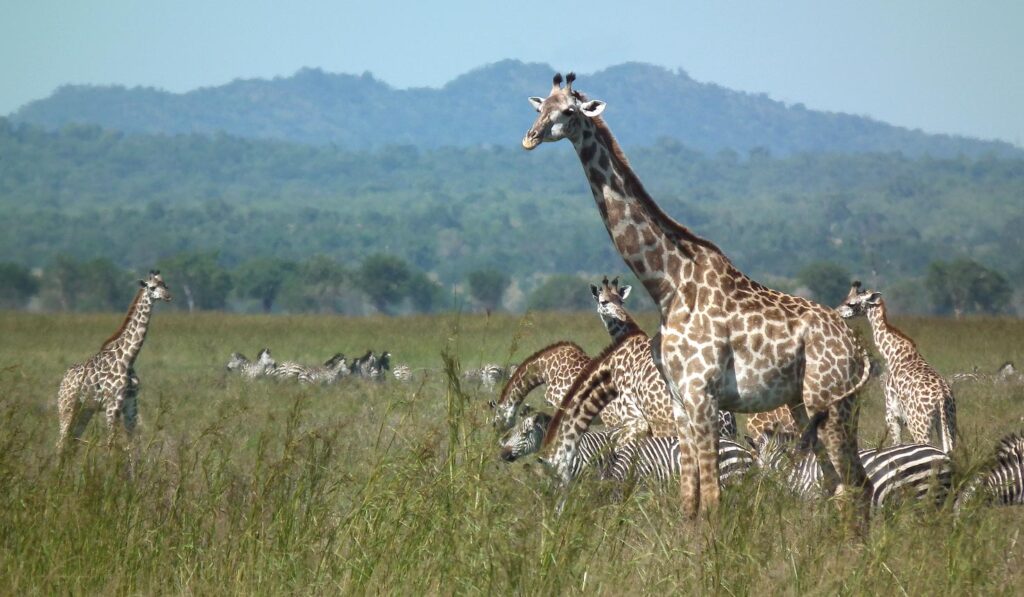
Walk the same stretch of savannah, and you might encounter greater kudu, those magnificent spiral-horned antelopes typically found in Southern Africa, alongside lesser kudu, an East African species. Observe both roan and sable antelope, their ranges overlapping here in ways they rarely do elsewhere. This fusion creates ornithological and mammalian diversity that keeps naturalists perpetually excited, never quite sure what unexpected species combination might appear next.
The landscape itself reflects this biological crossroads. Rocky kopjes characteristic of Southern African parks punctuate endless grasslands more typical of East Africa. Miombo woodlands—the distinctive Brachystegia-dominated forests of southern Tanzania, Zambia, and Zimbabwe—transition into acacia savannahs. The Great Ruaha River, flowing from highlands to lowlands, creates riparian corridors supporting yet another ecosystem entirely.
This diversity means Ruaha never feels monotonous despite its vast size. Every kilometer reveals different scenery, different wildlife assemblages, different photographic opportunities—ensuring that even multi-day safaris maintain constant freshness and discovery.
The Baobab Kingdom
If Ruaha National Park has a symbol, it’s the baobab—those impossibly ancient trees that seem to have been planted upside down, their branch-like roots reaching skyward. Ruaha harbors extraordinary baobab concentrations, with some specimens estimated at over 1,000 years old, their massive trunks scarred by centuries of elephants stripping bark, their hollow interiors sometimes large enough to shelter entire safari groups during sudden storms.
The baobabs create the park’s distinctive aesthetic. During the dry season (June-October), they stand leafless, their thick trunks glowing russet against golden grasslands and azure skies—every photographer’s dream subject. The landscape takes on an almost supernatural quality, these botanical giants seeming to defy gravity, logic, and conventional tree architecture.
Then the rains arrive (November onwards), transforming everything. Within weeks, baobabs burst into leaf, their crowns greening impossibly fast. They produce spectacular cream-colored flowers that open at night, pollinated by fruit bats in mutually beneficial relationships millions of years old. The fruits that follow—those velvety pods containing tart, vitamin-rich pulp—sustain wildlife and humans alike through lean seasons.
Elephants maintain complex relationships with baobabs. They strip bark for moisture during droughts, sometimes causing tree death but more often creating wounds the resilient baobabs eventually heal. Old bulls use massive trunks as rubbing posts, polishing the bark smooth. And occasionally, elephants simply knock entire baobabs over to access the moisture-rich inner wood—a reminder that even trees this ancient aren’t immune to elephant power.
The Lion Superpower
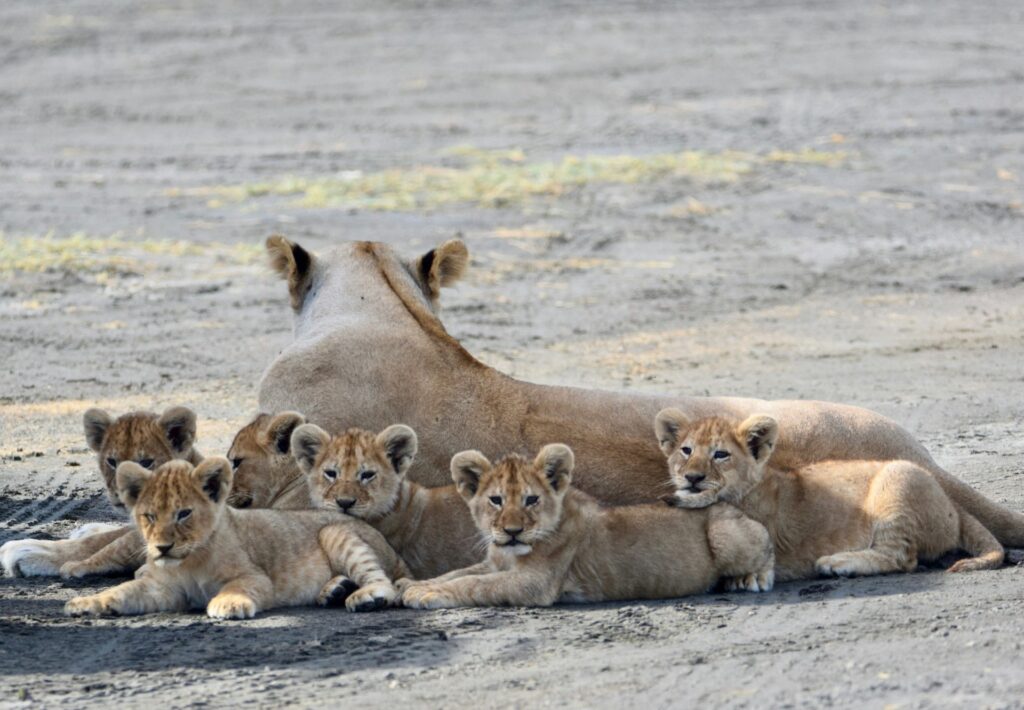
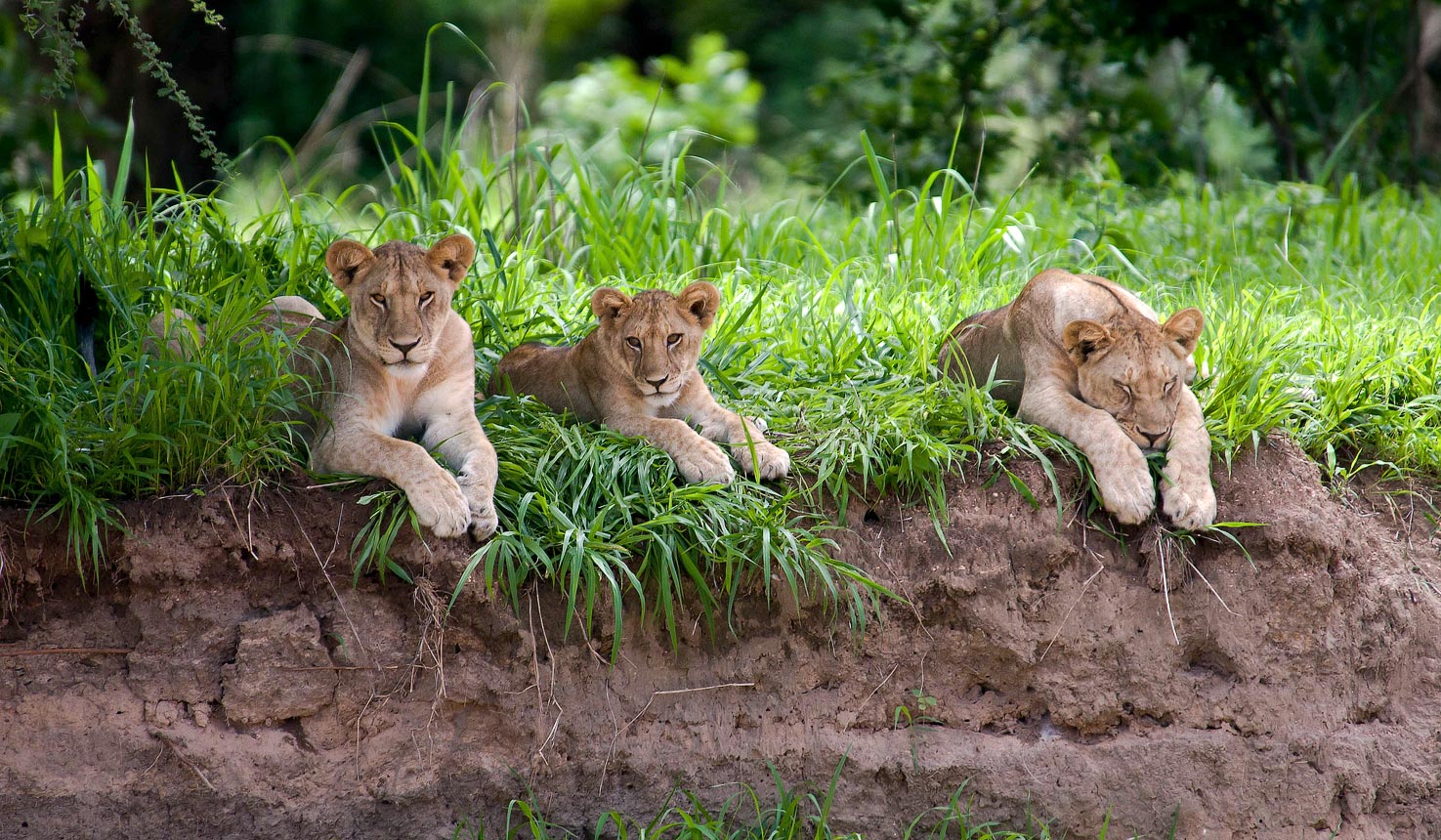
Ruaha harbors approximately 10% of the world’s remaining wild lions—a staggering statistic for a single park. More remarkably, these lions form some of East Africa’s largest recorded prides, with groups sometimes exceeding 25 individuals creating cooperative hunting machines capable of taking down adult buffalo bulls.
Watching a Ruaha lion pride operate reveals apex predator efficiency perfected over millennia. The coordinated movements, the assigned roles (some lions drive prey toward ambush positions, others wait hidden), the patience to wait hours for optimal striking moments, and the explosive power when attacks finally commence—it’s nature’s most sophisticated hunting strategy executed with precision that feels almost military.
Buffalo hunting proves particularly dramatic. A healthy adult buffalo bull can weigh 900 kilograms and possesses horns capable of goring lions to death. Taking one down requires multiple lions working perfectly together, accepting significant injury risk for the massive protein reward. These hunts can last hours, the buffalo fighting desperately while lions hang from its flanks, neck, and hindquarters until exhaustion and blood loss finally bring it down.
The dry season concentrates both predators and prey around the shrinking Great Ruaha River, creating wildlife densities and dramatic interactions rivaling anywhere in Africa. Lions patrol the riverbanks, knowing thirsty prey must eventually risk approaching water. The river becomes theater, the banks offering front-row seats to life-and-death dramas played out daily.
Elephant Country
With approximately 10,000 elephants, Ruaha National Park protects Tanzania’s largest elephant population and one of East Africa’s most significant. These aren’t timid, habituated elephants accustomed to vehicles. Ruaha’s elephants maintain healthy wariness of humans while displaying remarkable adaptation to the harsh, seasonal environment.
During the dry season, elephants dig for water in dry riverbeds, creating wells that benefit countless other species. They strip baobab bark for moisture and minerals. Family groups gather at permanent pools, hundreds sometimes congregating at favored waterholes creating scenes of social complexity—greeting ceremonies, playful youngsters, protective mothers, and elderly matriarchs whose wisdom guides entire families through decades.
Bull elephants in musth—that heightened testosterone state increasing mating success—patrol territories with swaggering confidence, occasionally engaging in spectacular dominance battles. Two massive bulls facing off, tusks clashing, trunks intertwined in trials of strength—it’s prehistoric combat that makes even lions retreat respectfully.
The Great Ruaha River: Lifeline Through Wilderness
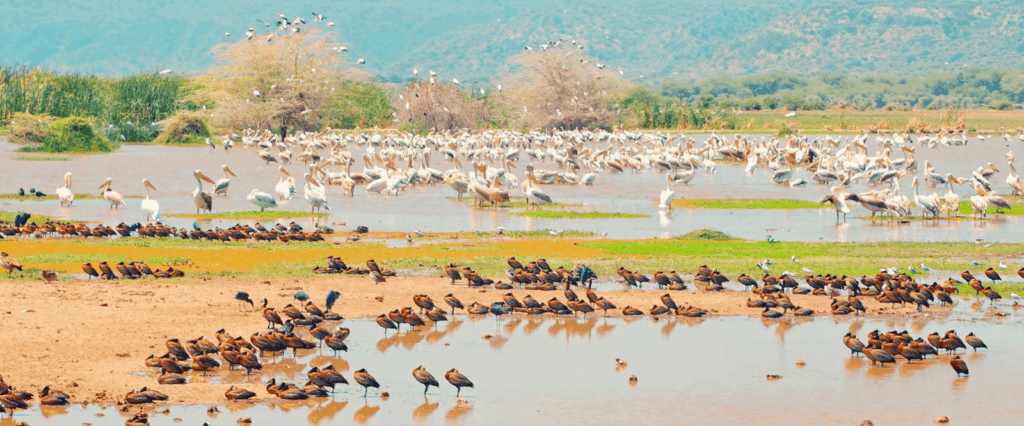
The river defines Ruaha. During the wet season, it flows powerfully, its banks supporting hippo pods, crocodile concentrations, and waterbird diversity. As months without rain progress, the river fragments into isolated pools—oases concentrating wildlife in ever-tightening circles.
These shrinking pools create natural amphitheaters for wildlife observation. Elephants bathe and drink, buffalo herds cool themselves in remaining depths, hippos pack impossibly tight in diminishing water, and predators patrol the margins knowing prey must eventually risk approaching.
The riverine forests lining the Great Ruaha create entirely different habitats—gallery forests supporting species rarely seen in surrounding grasslands. Leopards frequent these forests, their spotted coats blending perfectly with dappled shade. Greater kudu browse in the understory. And countless birds—kingfishers, herons, fish eagles—depend on these linear oases through otherwise arid landscapes.
Rungwa-Kizigo-Muhesi: Landscape-Scale Conservation
Ruaha doesn’t exist in isolation. It anchors the vast Rungwa-Kizigo-Muhesi ecosystem—45,000 square kilometers of interconnected protected areas including multiple game reserves and wildlife management areas. This landscape-scale conservation enables wildlife migrations, maintains genetic connectivity between populations, and preserves ecosystem processes operating at scales necessary for long-term health.
This connectivity explains Ruaha’s wildlife abundance. Elephants, lions, and other species move freely across the broader ecosystem, following rainfall patterns, tracking prey movements, and avoiding human pressures. The result: populations remain viable, genetic diversity stays healthy, and ecological processes continue functioning as they have for millennia.
Your Untamed Tanzania Awaits
Ruaha National Park offers what serious safari enthusiasts increasingly seek: genuine wilderness, minimal tourism impact, spectacular wildlife, and the satisfaction of experiencing Africa largely as it existed before mass tourism transformed it.
This is Tanzania’s wild heart—remote, magnificent, untamed. Where lions rule in unprecedented numbers, elephants roam by the thousands, and ancient baobabs stand witness to centuries of wild Africa’s eternal dramas.
Your authentic wilderness safari awaits in Ruaha’s golden grasslands.